


When (E)-3-methylhex-3-ene undergoes hydroboration–oxidation, two isomeric products are formed. Give their structures, and label each asymmetric carbon atom as (R) or (S). What is the relationship between these isomers? What is the relationship between the products formed from (Z)-3-methylhex-3-ene and those formed from (E)-3-methylhex-3-ene?
Ch.8 - Reactions of Alkenes
Chapter 8, Problem 15a
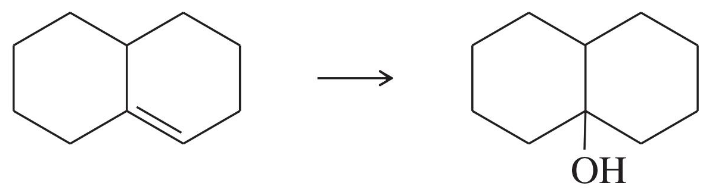
Show how you would accomplish the following transformations.
(a) 
Verified step by step guidance1
Step 1: Analyze the starting material and the product. The starting material is a bicyclic compound with a double bond, and the product is a bicyclic alcohol. This suggests that the transformation involves the addition of a hydroxyl group (-OH) to the double bond.
Step 2: Recognize that this transformation is likely an anti-Markovnikov addition of water to the double bond. Anti-Markovnikov hydration can be achieved using hydroboration-oxidation. The reagents required are BH₃·THF (borane in tetrahydrofuran) followed by H₂O₂ (hydrogen peroxide) and NaOH (sodium hydroxide).
Step 3: In the first step of hydroboration, BH₃·THF adds to the double bond in a syn addition manner, forming an organoborane intermediate. The boron atom attaches to the less substituted carbon of the double bond, ensuring anti-Markovnikov regioselectivity.
Step 4: In the second step, the organoborane intermediate is oxidized using H₂O₂ and NaOH. This replaces the boron atom with a hydroxyl group (-OH), resulting in the formation of the alcohol product.
Step 5: Since the product is chiral, the reaction produces a racemic mixture (both enantiomers) due to the formation of a new stereocenter during the addition of the hydroxyl group.

Verified video answer for a similar problem:
This video solution was recommended by our tutors as helpful for the problem above.
Video duration:
10mWas this helpful?
Key Concepts
Here are the essential concepts you must grasp in order to answer the question correctly.
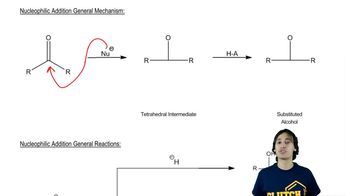
Nucleophilic Addition
Nucleophilic addition is a fundamental reaction mechanism in organic chemistry where a nucleophile attacks an electrophilic carbon atom, leading to the formation of a new bond. In the context of the transformation shown, a nucleophile, such as water or an alcohol, can add to a double bond or a carbonyl group, resulting in the formation of an alcohol. Understanding this mechanism is crucial for predicting the products of reactions involving unsaturated compounds.
Recommended video:
Guided course
Nucleophilic Addition
Stereochemistry
Stereochemistry refers to the study of the spatial arrangement of atoms in molecules and how this affects their chemical behavior. In the transformation depicted, the stereochemistry of the starting material and the product can influence the reaction pathway and the final product's properties. Recognizing the stereochemical implications is essential for understanding how different isomers can form and their reactivity.
Recommended video:
Polymer Stereochemistry Concept 1
Functional Group Transformation
Functional group transformation involves changing one functional group into another through chemical reactions. In the given transformation, a double bond is converted into an alcohol functional group, showcasing how organic compounds can be modified to achieve desired properties. Mastery of functional group transformations is vital for synthetic organic chemistry, allowing chemists to design and create complex molecules.
Recommended video:
Guided course
Identifying Functional Groups
Related Practice
Textbook Question
2376
views
Textbook Question
When HBr adds across the double bond of 1,2-dimethylcyclopentene, the product is a mixture of the cis and trans isomers. Show why this addition is not stereospecific.
2053
views
Textbook Question
Show how you would accomplish the following transformations.
(c) 1-methylcycloheptanol → 2-methylcycloheptanol
1473
views
1
rank
Textbook Question
Predict the major products of the following reactions. Include stereochemistry where applicable.
(c)
1978
views
1
comments
Textbook Question
Show how you would accomplish the following transformations.
(b)
1273
views
Textbook Question
When (Z)-3-methylhex-3-ene undergoes hydroboration–oxidation, two isomeric products are formed. Give their structures, and label each asymmetric carbon atom as (R) or (S). What is the relationship between these isomers?
1421
views
