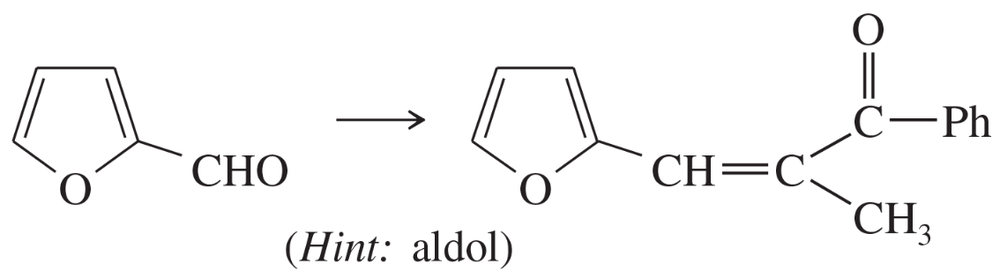
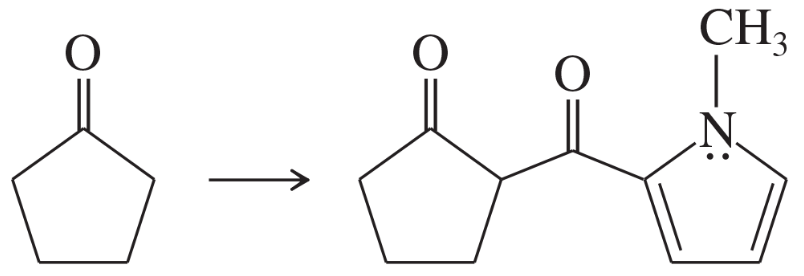
Show how you would accomplish the following conversions in good yields. You may use any necessary reagents. (d) (e) (f)
Verified step by step guidance
1
Step 1: For reaction (a), identify the starting material as acetophenone and the product as phenyl bromomethyl ketone. This conversion involves the bromination of the methyl group adjacent to the carbonyl group. Use bromine (Br2) in the presence of acid or base as a reagent to achieve this transformation.
Step 2: For reaction (b), the starting material is butanoic acid, and the product is 2-bromo-3-hydroxybutanoic acid. This conversion involves bromination at the alpha position of the carboxylic acid. Use bromine (Br2) in the presence of phosphorus tribromide (PBr3) or a similar catalyst to facilitate alpha-bromination.
Step 3: For reaction (c), the starting material is acetophenone, and the product is the enolate ion of acetophenone. This conversion involves deprotonation of the alpha hydrogen adjacent to the carbonyl group. Use a strong base such as sodium hydride (NaH) or sodium ethoxide (NaOEt) to generate the enolate ion.
Step 4: Ensure that the reaction conditions for each step are optimized to achieve good yields. For example, control the temperature and reaction time to minimize side reactions.
Step 5: Verify the stereochemistry and regioselectivity of the products, especially for reactions (b) and (c), where the formation of specific isomers or ions is critical.
Verified video answer for a similar problem:
This video solution was recommended by our tutors as helpful for the problem above
Video duration:
10m
Play a video:
Was this helpful?
Key Concepts
Here are the essential concepts you must grasp in order to answer the question correctly.
Hell-Volhard-Zelinski Reaction
The Hell-Volhard-Zelinski (HVZ) reaction is a method for the halogenation of carboxylic acids at the alpha position. It involves the formation of an acyl halide from the carboxylic acid, followed by halogenation using a halogen (like Br2) and a base. This reaction is particularly useful for introducing halogen substituents into organic molecules, which can further participate in various synthetic transformations.
Understanding the appropriate reagents and conditions is crucial for successful organic transformations. For the HVZ reaction, common reagents include phosphorus tribromide (PBr3) or thionyl chloride (SOCl2) to convert carboxylic acids to acyl halides, followed by the addition of a halogen. The choice of base, such as triethylamine, can also influence the reaction's efficiency and yield.
A solid grasp of reaction mechanisms is essential for predicting the outcomes of organic reactions. The HVZ reaction proceeds through a series of steps: formation of the acyl halide, nucleophilic attack by the halogen, and subsequent elimination of the leaving group. Understanding these steps helps in rationalizing the reaction conditions and optimizing yields for desired products.