Table of contents
- 1. A Review of General Chemistry
- Orgo 1: Pre-Course Review
- What is Organic Chemistry?
- Atomic Structure
- Wave Function
- Molecular Orbitals
- Sigma and Pi Bonds
- Octet Rule
- Bonding Preferences
- Formal Charges
- Skeletal Structure
- Lewis Structure
- Condensed Structural Formula
- Index of Hydrogen Deficiency (Structural)
- Constitutional Isomers
- Resonance Structures
- Hybridization
- Molecular Geometry
- Electronegativity
- 2. Molecular Representations
- 3. Acids and Bases
- 4. Alkanes and Cycloalkanes
- Alkane Nomenclature
- Common Substituents
- Cycloalkanes
- Bicyclics
- Alkyl Halides
- Alkenes, Alkynes and Alcohols
- Naming Alcohols
- Naming Amines
- Cis vs Trans
- Conformations
- Newman Projections – Conformational Energy
- Newman Projections – Method
- Barrier To Rotation
- Heat of Combustion
- Cyclohexane – Chairs and Positions
- Cyclohexane – Determination of Cis and Trans
- Equatorial Preference
- Chair Flip
- Calculating Flip Energy
- A-Values
- Decalin
- 5. Chirality
- Types of Isomers
- Chirality
- Chirality Test 1 - Internal Line of Symmetry
- Chirality Test 2 - Stereocenters
- Cahn-Ingold-Prelog Nomenclature
- Types of Stereoisomers
- Atropisomers
- Meso Compounds
- Chirality Test 3 - Disubstituted Cycloalkanes Shortcuts
- Isometric Relationships
- Fischer Projection
- Fischer Configurations
- Optical Activity
- Enantiomeric Excess
- Calculations with Enantiomeric Percentages
- Non-Carbon Chiral Centers
- 6. Thermodynamics and Kinetics
- 7. Substitution Reactions
- 8. Elimination Reactions
- 9. Alkenes and Alkynes
- 10. Addition Reactions
- General Mechanism – Addition Reaction
- Markovnikov's Rule
- Hydrohalogenation
- Acid-Catalyzed Hydration
- Oxymercuration-Reduction
- Hydroboration-Oxidation
- Catalytic Hydrogenation and Wilkinson's Catalyst
- Halogenation
- Halohydrin Formation
- Cyclopropanation
- Epoxidation
- Epoxide Ring Opening
- Syn Vicinal Dihydroxylation
- Weak Oxidative Cleavage
- Ozonolysis Full Mechanism
- Oxidative Cleavage
- Alkyne Oxidative Cleavage
- Alkyne Hydrohalogenation
- Alkyne Halogenation
- Alkyne Hydration
- Alkyne Hydroboration
- 11. Radical Reactions
- 12. Alcohols, Ethers, Epoxides and Thiols
- Alcohol Nomenclature
- Ether Nomenclature
- Epoxide Nomenclature
- Thiol and Sulfide Nomenclature
- Synthesis of Alcohols Overview
- Leaving Group Conversions - Using HX
- Leaving Group Conversions - SOCl2 and PBr3
- Leaving Group Conversions - Sulfonyl Chlorides
- Leaving Group Conversions Summary
- Williamson Ether Synthesis
- Making Ethers - Alcohol Condensation
- Making Ethers - Alkoxymercuration
- Making Ethers - Acid-Catalyzed Alkoxylation
- Making Ethers - Cumulative Practice
- Cleavage of Ethers
- Alcohol Protecting Groups
- t-Butyl Ether Protecting Groups
- Silyl Ether Protecting Groups
- Sharpless Asymmetric Epoxidation
- Reactions of Thiols
- Oxidation of Sulfides
- 13. Alcohols and Carbonyl Compounds
- 14. Synthetic Techniques
- 15. Analytical Techniques: IR, NMR, Mass Spect
- Purpose of Analytical Techniques
- Infrared Spectroscopy
- IR Spectroscopy - Frequencies
- IR Spect: Drawing Spectra
- IR Spect: Extra Practice
- 1H Nuclear Magnetic Resonance - General Features
- 1H NMR - Total Number of Signals
- 1H NMR - Proton Relationships
- 1H NMR: E/Z Diastereoisomerism
- 1H NMR - Chemical Shifts
- 1H NMR - Spin-Splitting without J-Values
- 1H NMR: Spin-Splitting Simple Tree Diagrams
- 1H NMR: Spin-Splitting Complex Tree Diagrams
- 1H NMR Spin-Splitting - Common Patterns
- 1H NMR - Integration
- NMR Practice
- 13C NMR - General Features
- Structure Determination - Molecular Sentences
- Mass Spect - Introduction
- Mass Spect - Fragmentation
- Mass Spect - Common Isotopes
- 16. Conjugated Systems
- Introduction to Conjugation
- Stability of Conjugated Intermediates
- Allylic Halogenation
- Reactions at the Allylic Position
- Conjugated Hydrohalogenation
- Diels-Alder Reaction - General Features
- Diels-Alder - Bridged Products
- Diels-Alder Retrosynthesis
- Basics of Molecular Orbital Theory
- Drawing Atomic Orbitals
- Drawing Molecular Orbitals
- Frontier Molecular Orbital Theory - Finding HOMO/LUMO
- Orbital Diagram:3-atoms- Allylic Ions
- Orbital Diagram:4-atoms- 1,3-butadiene
- Orbital Diagram:5-atoms- Allylic Ions
- Orbital Diagram:6-atoms- 1,3,5-hexatriene
- Orbital Diagram:Excited States
- Intro to Pericyclic Reactions
- Thermal Cycloaddition Reactions
- Photochemical Cycloaddition Reactions
- Thermal Electrocyclic Reactions
- Photochemical Electrocyclic Reactions
- Cumulative Electrocyclic Reactions
- Introduction to Sigmatropic Shifts
- Cope Rearrangement
- Claisen Rearrangement
- 17. Ultraviolet Spectroscopy
- 18. Aromaticity
- 19. Reactions of Aromatics: EAS and Beyond
- Electrophilic Aromatic Substitution – General Mechanism
- Electrophilic Aromatic Substitution – Reactions
- Generating Electrophiles – EAS Halogenation
- Generating Electrophiles – EAS Nitration
- Generating Electrophiles – Friedel-Crafts Alkylation
- Generating Electrophiles – Friedel-Crafts Acylation
- Generating Electrophiles – Any Carbocation
- EAS – Monosubstituted Benzene
- EAS-o, p-Major Products
- EAS – Protection of Aniline Derivatives
- Limitations of Friedel-Crafts Alkyation
- Advantages of Friedel-Crafts Acylation
- Blocking Groups - Sulfonic Acid
- EAS – Polysubstituted Benzene
- Side-Chain Halogenation
- Side-Chain Oxidation
- Reactions at Benzylic Positions
- Birch Reduction
- EAS – Sequence Groups
- EAS – Proposing Aromatic Synthesis
- Diazonium Compounds – Replacements Reactions
- Diazo Compounds – Sequence Groups
- Diazonium Compounds – Proposing Aromatic Synthesis
- SNAr Addition-Elimination Mechanism
- Benzyne Pathway – General Mechanism
- 20. Phenols
- 21. Aldehydes and Ketones: Nucleophilic Addition
- Aldehyde Nomenclature
- Ketone Nomenclature
- Intro to Redox
- Oxidation
- Weak Oxidative Cleavage
- Aldehyde Via Reducing Agents
- Alkyne Hydration
- Nucleophilic Addition
- Cyanohydrins
- Organometallics
- Nucleophilic Addition of Solvents
- Hydrates
- Hemiacetals
- Acetals
- Acetals as Protecting Groups
- Thioacetals and Raney Nickel Reduction
- Imines and Enamines
- Addition of Ammonia Derivatives
- Wolff Kishner Reduction
- Baeyer-Villiger Oxidation
- Ketones from Acid Chlorides
- Ketones from Nitriles
- Wittig Reaction
- Ketone and Aldehyde Synthesis Reactions
- 22. Carboxylic Acid Derivatives: NAS
- COOH Derivatives and Nucleophilic Acyl Substitution
- Carboxylic Acid Nomenclature
- Diacid Nomenclature
- Ester Nomenclature
- Nitrile Nomenclature
- Acid Chloride Nomenclature
- Anhydride Nomenclature
- Amide Nomenclature
- Nucleophilic Acyl Substitution – The Three Rules
- Specific Carboxylic Acid Conversions
- Fischer Esterification – Mechanism
- Acid-Catalyzed Ester Hydrolysis – Mechanism
- Base-Catalyzed Ester Hydrolysis – Mechanism
- Base-Catalyzed Transesterificaation – Mechanism
- Lactones, Lactams and Cyclization Reactions
- Carbonation of Grignard Reagents
- Decarboxylation
- Review of Nitriles
- 23. The Chemistry of Thioesters, Phophate Ester and Phosphate Anhydrides
- 24. Enolate Chemistry: Reactions at the Alpha-Carbon
- Alpha Carbons and Tautomerization
- Tautomers of Dicarbonyl Compounds
- Enolates
- Acid-Catalyzed Alpha-Halogenation
- Base-Catalyzed Alpha-Halogenation
- Haloform Reaction
- Hell-Volhard-Zelinski Reaction
- Overview of α-Carbon Alkylations and Acylations
- Enolate Alkylation and Acylation
- Enamine Alkylation and Acylation
- Beta-Dicarbonyl Synthesis Pathway
- Acetoacetic Ester Synthesis
- Malonic Ester Synthesis
- 25. Condensation Chemistry
- 26. Amines
- 27. Heterocycles
- Nomenclature of Heterocycles
- Acid-Base Properties of Nitrogen Heterocycles
- Reactions of Pyrrole, Furan, and Thiophene
- Directing Effects in Substituted Pyrroles, Furans, and Thiophenes
- Addition Reactions of Furan
- EAS Reactions of Pyridine
- SNAr Reactions of Pyridine
- Side-Chain Reactions of Substituted Pyridines
- 28. Carbohydrates
- Monosaccharide
- Monosaccharides – D and L Isomerism
- Monosaccharides – Drawing Fischer Projections
- Monosaccharides – Common Structures
- Monosaccharides – Forming Cyclic Hemiacetals
- Monosaccharides – Cyclization
- Monosaccharides – Haworth Projections
- Monosaccharides – Mutarotation
- Monosaccharides – Epimerization
- Monosaccharides – Aldose-Ketose Rearrangement
- Monosaccharides – Alkylation
- Monosaccharides – Acylation
- Monosaccharides – O-Glycosides
- Monosaccharides – N-Glycosides
- Monosaccharides – Reduction (Alditols)
- Monosaccharides – Weak Oxidation (Aldonic Acid)
- Monosaccharides – Reducing Sugars
- Monosaccharides – Strong Oxidation (Aldaric Acid)
- Monosaccharides – Oxidative Cleavage (Periodic Acid)
- Monosaccharides – Osazones
- Monosaccharides – Modern Kiliani-Fischer Synthesis
- Monosaccharides – Wohl Degradation
- Monosaccharides – Ruff Degradation
- Condensation Into Disaccharide
- Polysaccharides
- 29. Amino Acids
- Introduction to Proteins
- Amino Acid Configuration
- The 20 Amino Acids - Introduction
- Amino Acid Chart
- Acid-Base Properties of Amino Acids
- Isoelectric Point
- Amino Acid Synthesis: HVZ Method
- Synthesis of Amino Acids: Acetamidomalonic Ester Synthesis
- Synthesis of Amino Acids: N-Phthalimidomalonic Ester Synthesis
- Synthesis of Amino Acids: Strecker Synthesis
- Reactions of Amino Acids: Esterification
- Reactions of Amino Acids: Acylation
- Reactions of Amino Acids: Hydrogenolysis
- Reactions of Amino Acids: Ninhydrin Test
- 30. Peptides and Proteins
- Peptides
- Primary Protein Structure
- Secondary Protein Structure
- Tertiary Protein Structure
- Disulfide Bonds
- Quaternary Protein Structure
- Summary of Protein Structure
- Intro to Peptide Sequencing
- Peptide Sequencing: Partial Hydrolysis
- Peptide Sequencing: Partial Hydrolysis with Cyanogen Bromide
- Peptide Sequencing: Edman Degradation
- Merrifield Solid-Phase Peptide Synthesis
- 31. Catalysis in Organic Reactions
- 32. Lipids
- 33. The Organic Chemistry of Metabolic Pathways
- Intro to Metabolism
- ATP and Energy
- Intro to Coenzymes
- Coenzymes in Metabolism
- Energy Production in Biochemical Pathways
- Intro to Glycolysis
- Catabolism of Carbohydrates: Glycolysis
- Glycolysis Summary
- Pyruvate Oxidation (Simplified)
- Anaerobic Respiration
- Catabolism of Fats: Glycerol Metabolism
- Intro to Citric Acid Cycle
- Structures of the Citric Acid Cycle
- The Citric Acid Cycle
- 34. Nucleic Acids
- 35. Transition Metals
- Electron Configuration of Elements
- Coordination Complexes
- Ligands
- Electron Counting
- The 18 and 16 Electron Rule
- Cross-Coupling General Reactions
- Heck Reaction
- Stille Reaction
- Suzuki Reaction
- Sonogashira Coupling Reaction
- Fukuyama Coupling Reaction
- Kumada Coupling Reaction
- Negishi Coupling Reaction
- Buchwald-Hartwig Amination Reaction
- Eglinton Reaction
- Catalytic Allylic Alkylation
- Alkene Metathesis
- 36. Synthetic Polymers
- Introduction to Polymers
- Chain-Growth Polymers
- Radical Polymerization
- Cationic Polymerization
- Anionic Polymerization
- Polymer Stereochemistry
- Ziegler-Natta Polymerization
- Copolymers
- Step-Growth Polymers
- Step-Growth Polymers: Urethane
- Step-Growth Polymers: Polyurethane Mechanism
- Step-Growth Polymers: Epoxy Resin
- Polymers Structure and Properties
13. Alcohols and Carbonyl Compounds
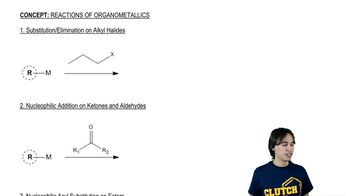
Reactions of Organometallics
13. Alcohols and Carbonyl Compounds
Reactions of Organometallics
 13:40
13:40

Practice this topic
- Multiple ChoicePredict the major, organic product for the following reaction.1237views
- Multiple ChoiceWhich of the following reactions will NOT produce a 3° alcohol as the major, organic product?1321views
- Multiple Choice
In a Grignard reaction, which key feature is formed as a result of the reaction between a Grignard reagent and a carbonyl compound?
212views - Multiple Choice
In a Grignard reaction, what is the key bond that is formed during the reaction?
209views