Textbook Question
(II) If the solenoid in Fig. 29–47 is being pulled away from the loop shown, in what direction is the induced current in the loop? Explain.
1391
views

 Giancoli Douglas 5th editionCh. 30 - Inductance, Electromagnetic Oscillations, and AC CircuitsProblem 13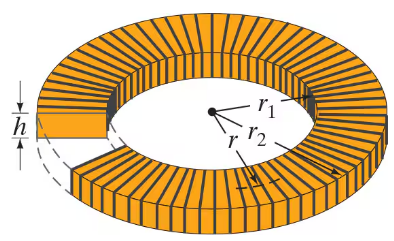
 Verified step by step guidance
 07:58
07:58
 10:20
10:20 11:47
11:47(II) If the solenoid in Fig. 29–47 is being pulled away from the loop shown, in what direction is the induced current in the loop? Explain.
(II) For the toroid of Fig. 30–26, determine the energy density in the magnetic field as a function of r(r₁ < r < r₂) and integrate this over the volume to obtain the total energy stored in the toroid, which carries a current I in each of its N loops.
<IMAGE>
A coil has 3.25-Ω resistance and 440-mH inductance. If the current is 3.00 A and is increasing at a rate of 3.15 A/s, what is the potential difference across the coil at this moment?
What is the energy density at the center of a circular loop of wire carrying a 19.0-A current if the radius of the loop is 28.0 cm?
The magnetic field inside an air-filled solenoid 38.0 cm long and 2.10 cm in diameter is 0.720 T. Approximately how much energy is stored in this field?
(II) Part of a single rectangular loop of wire with dimensions shown in Fig. 29–49 is situated inside a region of uniform magnetic field of 0.650 T. The total resistance of the loop is 0.250 Ω. Calculate the force required to pull the loop from the field (to the right) at a constant velocity of 3.40 m/s. Neglect gravity.