
Ch. 36 - The Special Theory of Relativity
Giancoli Douglas - Physics for Scientists and Engineers 5th edition
Giancoli Douglas5th editionPhysics for Scientists and EngineersISBN: 9780137488179Not the one you use?Change textbook
Chapter 35, Problem 83

Two protons, each having a speed of 0.945c in the laboratory, are moving toward each other. Determine (a) the momentum of each proton in the laboratory, (b) the total momentum of the two protons in the laboratory, and (c) the momentum of one proton as seen by the other proton.

Verified step by step guidance
1
Identify the mass of a proton, which is a constant value, and the speed of each proton given as 0.945 times the speed of light (c).
Calculate the relativistic momentum for each proton using the formula p = \( \gamma mv \), where \( m \) is the rest mass of the proton, \( v \) is the velocity of the proton, and \( \gamma \) is the Lorentz factor calculated by \( \gamma = \frac{1}{\sqrt{1 - \left(\frac{v}{c}\right)^2}} \).
For part (b), determine the total momentum of the two protons in the laboratory. Since they are moving directly towards each other with equal speeds, their momenta are equal in magnitude but opposite in direction, leading to a total momentum of zero.
For part (c), calculate the momentum of one proton as seen by the other. Use the relativistic velocity addition formula to find the relative velocity (V) of one proton with respect to the other: \( V = \frac{2v}{1 + \left(\frac{v^2}{c^2}\right)} \).
Using the relative velocity (V) obtained from the previous step, calculate the momentum of one proton as seen by the other using the same relativistic momentum formula p = \( \gamma mv \), substituting V for v.

Verified video answer for a similar problem:

This video solution was recommended by our tutors as helpful for the problem above.
Video duration:
11m
Was this helpful?

Key Concepts

Here are the essential concepts you must grasp in order to answer the question correctly.

Relativistic Momentum

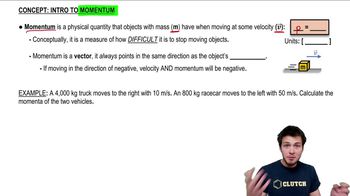
In relativistic physics, momentum is defined as the product of an object's mass and its velocity, modified by the Lorentz factor, which accounts for the effects of traveling at speeds close to the speed of light. The formula for relativistic momentum is p = γmv, where γ (gamma) is the Lorentz factor, given by γ = 1 / √(1 - v²/c²). This concept is crucial for accurately calculating the momentum of particles moving at relativistic speeds.
Recommended video:
Guided course
05:17
Intro to Momentum

Lorentz Factor

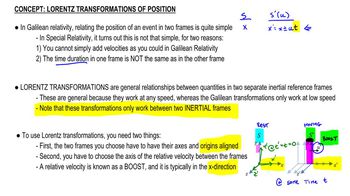
The Lorentz factor (γ) is a key component in the theory of relativity, representing the factor by which time, length, and relativistic mass increase as an object approaches the speed of light. It is calculated using the formula γ = 1 / √(1 - v²/c²), where v is the object's velocity and c is the speed of light. Understanding the Lorentz factor is essential for determining how relativistic effects influence momentum and other physical quantities.
Recommended video:
Guided course
14:16
Lorentz Transformations of Position

Conservation of Momentum

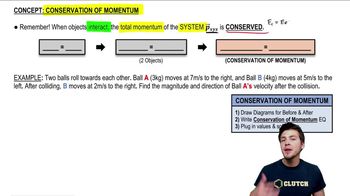
The principle of conservation of momentum states that the total momentum of a closed system remains constant if no external forces act upon it. In the context of two protons colliding, this principle allows us to analyze their momenta before and after the interaction. It is fundamental for solving problems involving collisions and interactions in both classical and relativistic physics.
Recommended video:
Guided course
05:58
Conservation Of Momentum
Related Practice
Textbook Question

How much energy would be required to break a helium nucleus into its constituents, two protons and two neutrons? The rest masses of a proton (including an electron), a neutron, and neutral helium are, respectively, 1.00783 u, 1.00867 u, and 4.00260 u. (This energy difference is called the total binding energy of the 24He_2^4\(\text{He}\) nucleus.)

82
views
Textbook Question

The Sun radiates energy at a rate of about 4 x 10²⁶ W.

(a) At what rate is the Sun’s mass decreasing?

(b) How long does it take for the Sun to lose a mass equal to that of Earth?

(c) Estimate how long the Sun could last if it radiated constantly at this rate.

998
views
Textbook Question

A spaceship and its occupants have a total mass of 160,000 kg. The occupants would like to travel to a star that is 32 light-years away at a speed of 0.70c. To accelerate, the engine of the spaceship changes mass directly to energy.

(a) Estimate how much mass will be converted to energy to accelerate the spaceship to this speed.

(b) Assuming the acceleration is rapid, so the speed for the entire trip can be taken to be 0.70c, determine how long the trip will take according to the astronauts on board.

831
views
Textbook Question

A quasar emits familiar hydrogen lines whose wavelengths are 8.5% longer than what we measure in the laboratory.

(a) Using the Doppler formula for light, estimate the speed of this quasar.

(b) What result would you obtain if you used the “classical” Doppler shift discussed in Chapter 16?

60
views
Textbook Question

What minimum amount of electromagnetic energy is needed to produce an electron and a positron together? A positron is a particle with the same mass as an electron, but has the opposite charge. (Note that electric charge is conserved in this process. See Section 37–5.)

990
views
Textbook Question

A pi meson of mass mπ decays at rest into a muon (mass mμ) and a neutrino of negligible or zero mass. Show that the kinetic energy of the muon is Kμ = (mπ - mμ)² c² / (2mπ).

1238
views