Ch. 1 - Angles and the Trigonometric Functions
Blitzer - Trigonometry 3rd Edition
Blitzer3rd EditionTrigonometryISBN: 9780137316601Not the one you use?Change textbook
Chapter 1, Problem 84

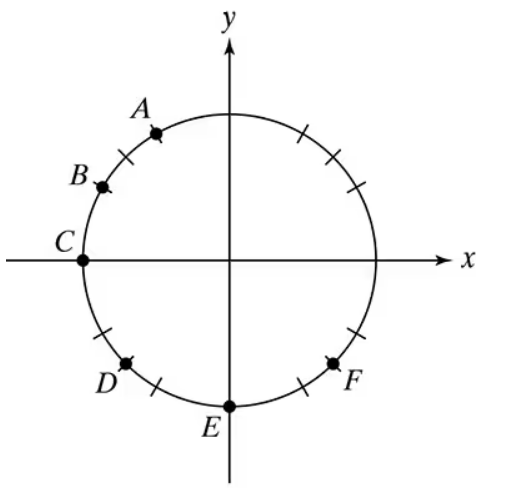
Use the circle shown in the rectangular coordinate system to solve Exercises 81–86. Find two angles, in radians, between -2πœ‹ and 2πœ‹ such that each angle's terminal side passes through the origin and the given point.
Unit circle centered at the origin on an xy-coordinate plane with labeled points A, B, C, D, E, and F.
F

Verified step by step guidance
1
Identify the coordinates of point Z on the unit circle. From the image, point Z is located in the fourth quadrant, near the positive x-axis and negative y-axis.
Determine the reference angle \( \theta_r \) that point Z makes with the positive x-axis. Since the circle is divided into 12 equal parts, each part corresponds to an angle of \( \frac{2\pi}{12} = \frac{\pi}{6} \). Point Z is located at the 11th tick mark, so the reference angle is \( \theta_r = \frac{\pi}{6} \).
Find the first angle \( \theta_1 \) in radians between \( -2\pi \) and \( 2\pi \) whose terminal side passes through point Z. Since Z is in the fourth quadrant, \( \theta_1 = 2\pi - \theta_r = 2\pi - \frac{\pi}{6} \).
Find the second angle \( \theta_2 \) in radians between \( -2\pi \) and \( 2\pi \) whose terminal side passes through point Z. This angle is the negative coterminal angle of \( \theta_1 \), so \( \theta_2 = \theta_1 - 2\pi = (2\pi - \frac{\pi}{6}) - 2\pi = -\frac{\pi}{6} \).
Verify that both angles \( \theta_1 \) and \( \theta_2 \) lie within the interval \( -2\pi \) to \( 2\pi \) and that their terminal sides pass through point Z on the unit circle.

Verified video answer for a similar problem:

This video solution was recommended by our tutors as helpful for the problem above.
Video duration:
8m
Was this helpful?

Key Concepts

Here are the essential concepts you must grasp in order to answer the question correctly.

Unit Circle and Angle Measurement

The unit circle is a circle with radius 1 centered at the origin of the coordinate system. Angles in radians are measured from the positive x-axis, with positive angles rotating counterclockwise and negative angles clockwise. Understanding the unit circle helps relate points on the circle to their corresponding angle measures.
Recommended video:
06:11
Introduction to the Unit Circle

Terminal Side of an Angle

The terminal side of an angle is the ray that starts at the origin and passes through a point on the circle. Identifying the terminal side helps determine the angle's measure. Since angles can be coterminal, multiple angles can share the same terminal side but differ by multiples of 2Ο€.
Recommended video:
04:46
Coterminal Angles

Finding Angles Between -2Ο€ and 2Ο€

To find angles between -2Ο€ and 2Ο€ with a given terminal side, consider both positive and negative rotations. For a point on the circle, one angle is the principal angle (0 to 2Ο€), and the other is its negative coterminal angle (between -2Ο€ and 0). This ensures all possible angles within the specified range are found.
Recommended video:
04:33
Find the Angle Between Vectors