Ch. 7 - Applications of Trigonometry and Vectors
Lial - Trigonometry 12th Edition
Lial12th EditionTrigonometryISBN: 9780136552161Not the one you use?Change textbook
Chapter 8, Problem 21

Solve each triangle ABC that exists.
A = 42.5°, a = 15.6 ft, b = 8.14 ft

Verified step by step guidance
1
Identify the given elements of the triangle: angle \(A = 42.5^\circ\), side \(a = 15.6\) ft (opposite angle \(A\)), and side \(b = 8.14\) ft (opposite angle \(B\)). We need to find the remaining parts of the triangle: angle \(B\), angle \(C\), and side \(c\).
Use the Law of Sines to find angle \(B\). The Law of Sines states: \(\frac{a}{\sin A} = \frac{b}{\sin B}\). Rearranged to solve for \(\sin B\), it becomes \(\sin B = \frac{b \cdot \sin A}{a}\).
Calculate \(\sin B\) using the values of \(a\), \(b\), and \(A\). Then, find angle \(B\) by taking the inverse sine (arcsin) of \(\sin B\). Remember that the sine function can have two possible angles in the range \(0^\circ\) to \(180^\circ\), so consider both possible solutions for \(B\) (the ambiguous case).
Once angle \(B\) is found, calculate angle \(C\) using the fact that the sum of angles in a triangle is \(180^\circ\): \(C = 180^\circ - A - B\).
Finally, use the Law of Sines again to find side \(c\): \(\frac{c}{\sin C} = \frac{a}{\sin A}\), which rearranges to \(c = \frac{a \cdot \sin C}{\sin A}\). This completes the solution of the triangle.

Verified video answer for a similar problem:

This video solution was recommended by our tutors as helpful for the problem above.
Was this helpful?

Key Concepts

Here are the essential concepts you must grasp in order to answer the question correctly.

Law of Sines

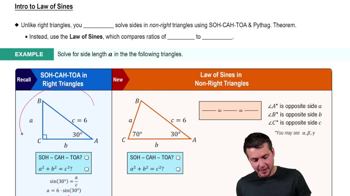
The Law of Sines relates the sides and angles of a triangle through the ratio a/sin(A) = b/sin(B) = c/sin(C). It is essential for solving triangles when two sides and an angle are known, allowing calculation of unknown angles or sides.
Recommended video:
4:27
Intro to Law of Sines

Triangle Ambiguity (SSA Case)

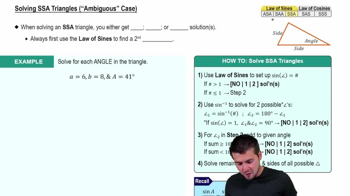
When two sides and a non-included angle (SSA) are given, there may be zero, one, or two possible triangles. Understanding this ambiguity helps determine if multiple solutions exist or if the triangle is unique or impossible.
Recommended video:
9:50
Solving SSA Triangles ("Ambiguous" Case)

Sum of Angles in a Triangle

The sum of the interior angles in any triangle is always 180°. After finding one unknown angle using the Law of Sines, this property helps find the remaining angle to complete the triangle.
Recommended video:
4:47
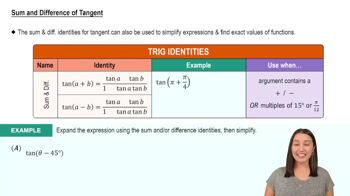
Sum and Difference of Tangent