Ch. 1 - Trigonometric Functions
Lial - Trigonometry 12th Edition
Lial12th EditionTrigonometryISBN: 9780136552161Not the one you use?Change textbook
Chapter 2, Problem 40

Identify the quadrant (or possible quadrants) of an angle θ that satisfies the given conditions. See Example 3. cos θ > 0 , sec θ > 0

Verified step by step guidance
1
Recall the definitions and relationships between cosine and secant: \(\cos \theta\) is the cosine of the angle, and \(\sec \theta\) is its reciprocal, defined as \(\sec \theta = \frac{1}{\cos \theta}\).
Given that \(\cos \theta > 0\), this means the cosine value is positive. Cosine corresponds to the x-coordinate on the unit circle, so the angle \(\theta\) lies where the x-coordinate is positive.
Since \(\sec \theta = \frac{1}{\cos \theta}\), if \(\cos \theta > 0\), then \(\sec \theta\) must also be positive. This confirms the conditions are consistent and point to the same quadrants.
Recall the signs of cosine in each quadrant: cosine is positive in Quadrant I and Quadrant IV, and negative in Quadrant II and Quadrant III.
Therefore, the angle \(\theta\) must lie in Quadrant I or Quadrant IV, where both \(\cos \theta\) and \(\sec \theta\) are positive.

Verified video answer for a similar problem:

This video solution was recommended by our tutors as helpful for the problem above.
Video duration:
3m
Was this helpful?

Key Concepts

Here are the essential concepts you must grasp in order to answer the question correctly.

Relationship Between Cosine and Secant

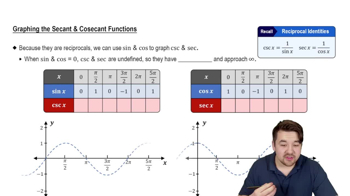
Cosine and secant are reciprocal trigonometric functions, meaning sec θ = 1/cos θ. Therefore, if cos θ > 0, sec θ must also be positive, and vice versa. Understanding this reciprocal relationship helps determine the sign of one function based on the other.
Recommended video:
6:22
Graphs of Secant and Cosecant Functions

Signs of Trigonometric Functions in Quadrants

The signs of cosine and secant depend on the quadrant in which the angle θ lies. Cosine (and secant) is positive in the first and fourth quadrants, and negative in the second and third. Identifying the quadrant based on function signs is essential for solving the problem.
Recommended video:
6:36
Quadratic Formula

Quadrant Identification Using Inequalities

Given inequalities like cos θ > 0 and sec θ > 0, one can deduce the possible quadrants for θ by matching these conditions with the known sign patterns of trigonometric functions in each quadrant. This method is a fundamental approach to locating angles on the unit circle.
Recommended video:
6:36
Quadratic Formula