Ch. 1 - Trigonometric Functions
Lial - Trigonometry 12th Edition
Lial12th EditionTrigonometryISBN: 9780136552161Not the one you use?Change textbook
Chapter 2, Problem 7

CONCEPT PREVIEW The terminal side of an angle θ in standard position passes through the point (― 3,― I3) Use the figure to find the following values. Rationalize denominators when applicable. r

Verified step by step guidance
1
Identify the coordinates of the point through which the terminal side of the angle \( \theta \) passes. Here, the point is given as \( (-3, -\sqrt{3}) \).
Recall that \( r \) represents the distance from the origin to the point \( (x, y) \) on the terminal side of the angle. This distance \( r \) is the hypotenuse of the right triangle formed by the x-axis and the point.
Use the distance formula to find \( r \): \(\n\[\n\)\( r = \sqrt{x^2 + y^2} \) \(\n\]\nSubstitute\) \( x = -3 \) and \( y = -\sqrt{3} \) into the formula.
Calculate \( r \) by squaring each coordinate, adding them, and then taking the square root: \(\n\)\(\n\)\( r = \sqrt{(-3)^2 + (-\sqrt{3})^2} = \sqrt{9 + 3} \).
Simplify the expression under the square root to get \( r = \sqrt{12} \). Then, simplify \( \sqrt{12} \) by factoring out perfect squares and rationalize the denominator if necessary.

Verified video answer for a similar problem:

This video solution was recommended by our tutors as helpful for the problem above.
Video duration:
1m
Was this helpful?

Key Concepts

Here are the essential concepts you must grasp in order to answer the question correctly.

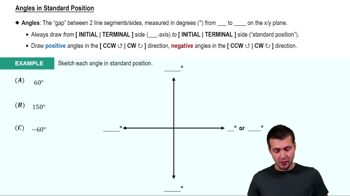
Standard Position of an Angle

An angle is in standard position when its vertex is at the origin and its initial side lies along the positive x-axis. The terminal side is the ray that rotates from the initial side to form the angle θ. Understanding this helps locate points on the terminal side and relate coordinates to trigonometric values.
Recommended video:
05:50
Drawing Angles in Standard Position

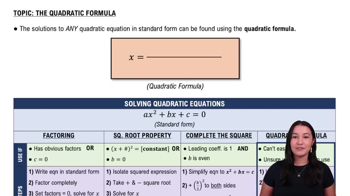
Distance Formula and Radius (r)

The radius r is the distance from the origin to the point (x, y) on the terminal side, calculated using r = √(x² + y²). This value is essential for defining trigonometric functions like sine, cosine, and tangent based on the coordinates of the point.
Recommended video:
6:36
Quadratic Formula

Trigonometric Ratios from Coordinates

Given a point (x, y) on the terminal side, sine, cosine, and tangent of θ are defined as sin θ = y/r, cos θ = x/r, and tan θ = y/x. These ratios allow calculation of trigonometric values directly from the point's coordinates, facilitating problem solving in trigonometry.
Recommended video:
05:32
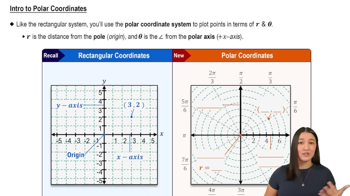
Intro to Polar Coordinates