Match each function with its graph in choices A - D.
y = sec (x - π/2)
Verified step by step guidance
1
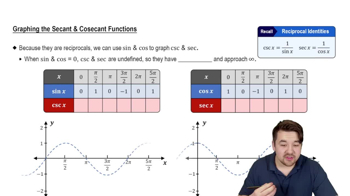
Identify the basic form of the secant function, which is \( y = \sec(x) \). The secant function is the reciprocal of the cosine function, \( y = \frac{1}{\cos(x)} \).
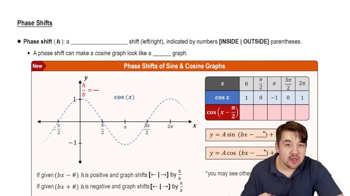
Recognize that the given function is \( y = \sec(x - \frac{\pi}{2}) \). This indicates a horizontal shift of the secant function by \( \frac{\pi}{2} \) units to the right.
Recall that the secant function has vertical asymptotes where the cosine function is zero. For \( y = \sec(x) \), these occur at \( x = \frac{\pi}{2} + n\pi \), where \( n \) is an integer.
Apply the horizontal shift to the asymptotes: the new asymptotes for \( y = \sec(x - \frac{\pi}{2}) \) will be at \( x = \pi + n\pi \).
Sketch the graph by plotting the vertical asymptotes and the general shape of the secant function, which consists of repeating U-shaped curves between the asymptotes, opening upwards and downwards.
Verified video answer for a similar problem:
This video solution was recommended by our tutors as helpful for the problem above
Play a video:
0 Comments
Key Concepts
Here are the essential concepts you must grasp in order to answer the question correctly.
Secant Function
The secant function, denoted as sec(x), is the reciprocal of the cosine function. It is defined as sec(x) = 1/cos(x). The secant function has vertical asymptotes where the cosine function is zero, which occurs at odd multiples of π/2. Understanding the behavior of the secant function is crucial for analyzing its graph.
A phase shift refers to a horizontal translation of a function's graph. In the function y = sec(x - π/2), the term (x - π/2) indicates a shift to the right by π/2 units. This shift affects the location of the vertical asymptotes and the overall appearance of the graph, making it essential to identify the correct graph among the choices.
Graphing trigonometric functions involves understanding their periodic nature, amplitude, and asymptotic behavior. For the secant function, the graph consists of U-shaped curves that open upwards or downwards, with vertical asymptotes at points where the cosine function is zero. Familiarity with these characteristics helps in accurately matching the function to its corresponding graph.