Ch. 5 - Complex Numbers, Polar Coordinates and Parametric Equations
Blitzer - Trigonometry 3rd Edition
Blitzer3rd EditionTrigonometryISBN: 9780137316601Not the one you use?Change textbook
Chapter 5, Problem 11

Use a polar coordinate system like the one shown for Exercises 1–10 to plot each point with the given polar coordinates. (2, 45°)

Verified step by step guidance
1
Understand that the polar coordinates are given in the form \((r, \theta)\), where \(r\) is the distance from the origin and \(\theta\) is the angle measured from the positive x-axis (polar axis) in degrees.
Identify the given coordinates: \(r = 2\) and \(\theta = 45^\circ\).
Locate the angle \(45^\circ\) on the polar coordinate system. This angle is measured counterclockwise from the positive x-axis.
From the origin, move along the line that makes a \(45^\circ\) angle with the positive x-axis.
Mark the point at a distance of 2 units from the origin along this line. This is the point with polar coordinates \((2, 45^\circ)\).

Verified video answer for a similar problem:

This video solution was recommended by our tutors as helpful for the problem above.
Video duration:
1m
Was this helpful?

Key Concepts

Here are the essential concepts you must grasp in order to answer the question correctly.

Polar Coordinate System

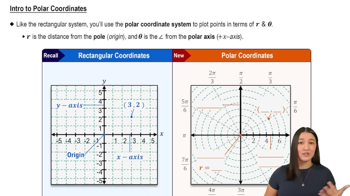
The polar coordinate system represents points in a plane using a distance and an angle from a fixed origin. Each point is defined by (r, θ), where r is the radius or distance from the origin, and θ is the angle measured in degrees or radians from the positive x-axis.
Recommended video:
05:32
Intro to Polar Coordinates

Plotting Points Using Polar Coordinates

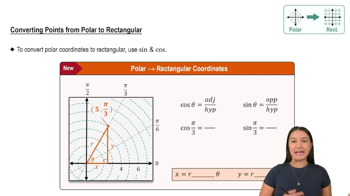
To plot a point given in polar coordinates (r, θ), start at the origin, measure the angle θ counterclockwise from the positive x-axis, then move outward along that direction by the distance r. This locates the point accurately on the plane.
Recommended video:
06:17
Convert Points from Polar to Rectangular

Angle Measurement in Degrees

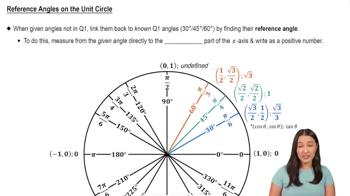
Angles in polar coordinates are often given in degrees, measured counterclockwise from the positive x-axis. Understanding how to interpret and measure these angles is essential for correctly positioning points in the polar plane.
Recommended video:
5:31
Reference Angles on the Unit Circle