For what value(s) of x is |x| = 4 true?
Table of contents
- 0. Review of College Algebra4h 45m
- 1. Measuring Angles40m
- 2. Trigonometric Functions on Right Triangles2h 5m
- 3. Unit Circle1h 19m
- 4. Graphing Trigonometric Functions1h 19m
- 5. Inverse Trigonometric Functions and Basic Trigonometric Equations1h 41m
- 6. Trigonometric Identities and More Equations2h 34m
- 7. Non-Right Triangles1h 38m
- 8. Vectors2h 25m
- 9. Polar Equations2h 5m
- 10. Parametric Equations1h 6m
- 11. Graphing Complex Numbers1h 7m
0. Review of College Algebra
Solving Linear Equations
Problem 19
Textbook Question
Solve each linear equation. See Examples 1–3. 6(3x - 1) = 8 - (10x - 14)
Verified step by step guidance1
Start by expanding both sides of the equation: apply the distributive property to remove parentheses. For the left side, multiply 6 by each term inside the parentheses: \(6(3x - 1) = 6 \times 3x - 6 \times 1\). For the right side, distribute the negative sign across the terms inside the parentheses: \(-(10x - 14) = -10x + 14\).
Rewrite the equation after distribution: the left side becomes \$18x - 6\(, and the right side becomes \)8 - 10x + 14\(. Combine like terms on the right side by adding the constants \)8\( and \)14$.
Next, collect all variable terms on one side and constants on the other. You can add or subtract terms from both sides to isolate \(x\). For example, add \$10x\( to both sides and add \)6$ to both sides to move terms accordingly.
After rearranging, combine like terms on each side to simplify the equation to the form \(ax = b\), where \(a\) and \(b\) are constants.
Finally, solve for \(x\) by dividing both sides of the equation by the coefficient \(a\). This will give you the solution for \(x\).
Verified video answer for a similar problem:This video solution was recommended by our tutors as helpful for the problem above
Video duration:
2mPlay a video:
0 Comments
Key Concepts
Here are the essential concepts you must grasp in order to answer the question correctly.
Distributive Property
The distributive property allows you to multiply a single term by each term inside parentheses. For example, a(b + c) = ab + ac. This is essential for simplifying expressions like 6(3x - 1) by distributing 6 to both 3x and -1.
Recommended video:
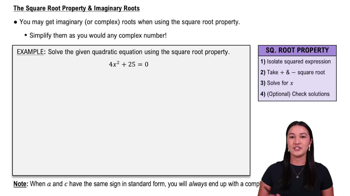
Imaginary Roots with the Square Root Property
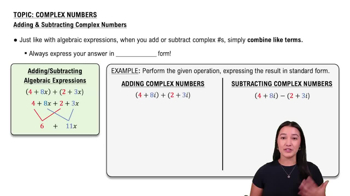
Combining Like Terms
Combining like terms involves adding or subtracting terms that have the same variable raised to the same power. This simplifies expressions and makes solving equations easier, such as combining terms with x on one side of the equation.
Recommended video:
Adding and Subtracting Complex Numbers
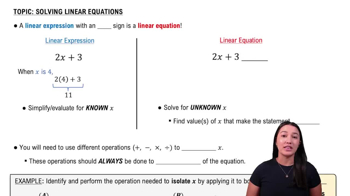
Solving Linear Equations
Solving linear equations means finding the value of the variable that makes the equation true. This involves isolating the variable by performing inverse operations like addition, subtraction, multiplication, or division on both sides of the equation.
Recommended video:
Solving Linear Equations
Related Videos
Related Practice
Textbook Question
3
views