Textbook Question
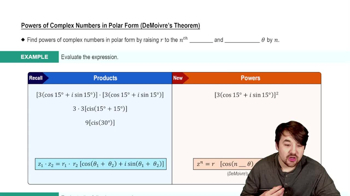
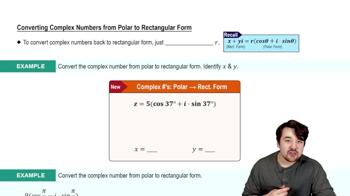
In Exercises 53–64, use DeMoivre's Theorem to find the indicated power of the complex number. Write answers in rectangular form. [2(cos 80° + i sin 80°)]³
640
views

 Blitzer 3rd EditionCh. 5 - Complex Numbers, Polar Coordinates and Parametric EquationsProblem 5.2.56
 Verified step by step guidance
 03:41
03:41
 03:58
03:58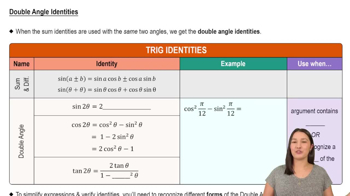 05:06
05:06In Exercises 53–64, use DeMoivre's Theorem to find the indicated power of the complex number. Write answers in rectangular form. [2(cos 80° + i sin 80°)]³
In Exercises 59–74, convert each polar equation to a rectangular equation. Then use a rectangular coordinate system to graph the rectangular equation. r = 4 csc θ
In Exercises 45–52, find the quotient z₁/z₂ of the complex numbers. Leave answers in polar form. In Exercises 49–50, express the argument as an angle between 0° and 360°.
z₁ = cos 80° + i sin 80°
z₂ = cos 200° + i sin 200°
In Exercises 49–58, convert each rectangular equation to a polar equation that expresses r in terms of θ. 3x + y = 7
In Exercises 53–64, use DeMoivre's Theorem to find the indicated power of the complex number. Write answers in rectangular form. [1/2 (cos π/12 + i sin π/12)]⁶
In Exercises 45–52, use your answers from Exercises 41–44 and the parametric equations given in Exercises 41–44 to find a set of parametric equations for the conic section or the line.
Circle: Center: (3,5); Radius: 6