In Exercises 33–38, find the area of the triangle having the given measurements. Round to the nearest square unit. C = 102°, a = 16 meters, b = 20 meters
Ch. 4 - Laws of Sines and Cosines; Vectors

Chapter 4, Problem 36
If u = 5i + 2j, v = i - j, and w = 3i - 7j, find u ⋅ (v + w).
Verified step by step guidance1
First, understand that the problem requires finding the dot product of vector \( u \) with the sum of vectors \( v \) and \( w \). The dot product is defined as \( \mathbf{a} \cdot \mathbf{b} = a_x b_x + a_y b_y \) for 2D vectors.
Calculate the vector sum \( \mathbf{v} + \mathbf{w} \) by adding their corresponding components: \( (v_x + w_x) \) for the i-component and \( (v_y + w_y) \) for the j-component.
Write down the resulting vector from step 2 explicitly as \( \mathbf{v} + \mathbf{w} = (v_x + w_x)\mathbf{i} + (v_y + w_y)\mathbf{j} \).
Now, compute the dot product \( \mathbf{u} \cdot (\mathbf{v} + \mathbf{w}) \) by multiplying the i-components of \( \mathbf{u} \) and \( \mathbf{v} + \mathbf{w} \), and the j-components of \( \mathbf{u} \) and \( \mathbf{v} + \mathbf{w} \), then summing these products: \( u_x (v_x + w_x) + u_y (v_y + w_y) \).
Express the final dot product as a sum of products of components without calculating the numerical value, which completes the setup for the solution.

Verified video answer for a similar problem:
This video solution was recommended by our tutors as helpful for the problem above.
Video duration:
2mWas this helpful?
Key Concepts
Here are the essential concepts you must grasp in order to answer the question correctly.
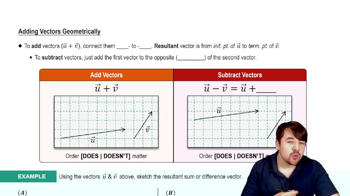
Vector Addition
Vector addition involves combining two vectors by adding their corresponding components. For example, if v = i - j and w = 3i - 7j, then v + w = (1+3)i + (-1-7)j = 4i - 8j. This operation is essential before performing the dot product in the given problem.
Recommended video:
Adding Vectors Geometrically
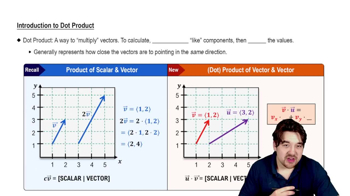
Dot Product of Vectors
The dot product of two vectors u and v is a scalar calculated by multiplying their corresponding components and summing the results. For vectors u = a1i + b1j and v = a2i + b2j, u ⋅ v = a1a2 + b1b2. This operation measures the extent to which two vectors point in the same direction.
Recommended video:
Introduction to Dot Product
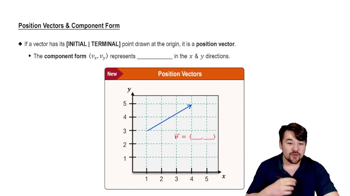
Component Form of Vectors
Vectors can be expressed in component form using unit vectors i and j along the x and y axes, respectively. This form allows easy manipulation of vectors through addition, subtraction, and dot product by working directly with their components.
Recommended video:
Position Vectors & Component Form
Related Practice
Textbook Question
920
views
Textbook Question
In Exercises 35–36, the three given points are the vertices of a triangle. Solve each triangle, rounding lengths of sides to the nearest tenth and angle measures to the nearest degree.
A(0, 0), B(-3, 4), C(3, -1)
718
views
Textbook Question
In Exercises 33–38, find the area of the triangle having the given measurements. Round to the nearest square unit.
B = 125°, a = 8 yards, c = 5 yards
858
views
Textbook Question
In Exercises 21–38, let u = 2i - 5j, v = -3i + 7j, and w = -i - 6j. Find each specified vector or scalar.
||2u||
772
views
Textbook Question
In Exercises 33–38, find projᵥᵥ v. Then decompose v into two vectors, v₁ and v₂, where v₁ is parallel to w and v₂ is orthogonal to w.
v = i + 2j, w = 3i + 6j
834
views
Textbook Question
In Exercises 21–38, let u = 2i - 5j, v = -3i + 7j, and w = -i - 6j. Find each specified vector or scalar.
||w - u||
880
views