Ch. R - Algebra Review
Lial - Trigonometry 12th Edition
Lial12th EditionTrigonometryISBN: 9780136552161Not the one you use?Change textbook
Chapter 1, Problem 75

Simplify each complex fraction. See Examples 5 and 6. [ (−4/3) + 12/5 ] / [ 1 − (−4/3)(12/5) ]

Verified step by step guidance
1
Identify the complex fraction structure: the numerator is \(\left(-\frac{4}{3}\right) + \frac{12}{5}\) and the denominator is \(1 - \left(-\frac{4}{3}\right) \times \frac{12}{5}\).
Simplify the numerator by finding a common denominator and adding the fractions: calculate \(-\frac{4}{3} + \frac{12}{5}\).
Simplify the denominator by first multiplying the fractions inside the parentheses: compute \(\left(-\frac{4}{3}\right) \times \frac{12}{5}\), then subtract this product from 1.
Rewrite the complex fraction as a division of two simplified fractions: \(\frac{\text{numerator}}{\text{denominator}}\) becomes \(\text{numerator} \div \text{denominator}\).
Perform the division by multiplying the numerator by the reciprocal of the denominator, then simplify the resulting fraction by reducing common factors.

Verified video answer for a similar problem:

This video solution was recommended by our tutors as helpful for the problem above.
Video duration:
4m
Was this helpful?

Key Concepts

Here are the essential concepts you must grasp in order to answer the question correctly.

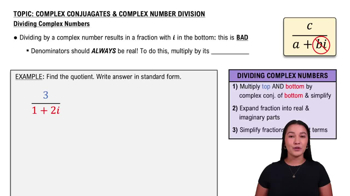
Complex Fractions

A complex fraction is a fraction where the numerator, denominator, or both contain fractions themselves. Simplifying involves rewriting the expression to eliminate the smaller fractions by finding common denominators or multiplying numerator and denominator appropriately.
Recommended video:
4:22
Dividing Complex Numbers

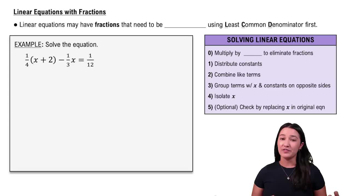
Operations with Fractions

Adding, subtracting, multiplying, and dividing fractions require finding common denominators or multiplying numerators and denominators directly. Understanding how to manipulate fractions is essential to simplify expressions accurately.
Recommended video:
4:02
Solving Linear Equations with Fractions

Order of Operations and Negative Signs

Applying the correct order of operations (PEMDAS) ensures accurate simplification, especially when dealing with negative signs and parentheses. Careful handling of negative fractions and multiplication prevents sign errors in the final result.
Recommended video:
04:12
Algebraic Operations on Vectors