Ch. 1 - Angles and the Trigonometric Functions
Blitzer - Trigonometry 3rd Edition
Blitzer3rd EditionTrigonometryISBN: 9780137316601Not the one you use?Change textbook
Chapter 1, Problem 1.19a

Use the unit circle shown to find the value of the trigonometric function.
cos πœ‹/6

Verified step by step guidance
1
Identify the angle \( \frac{\pi}{6} \) on the unit circle. This angle corresponds to 30 degrees.
Recall that the unit circle is a circle with a radius of 1 centered at the origin of the coordinate plane.
On the unit circle, the coordinates of a point corresponding to an angle \( \theta \) are \((\cos \theta, \sin \theta)\).
For \( \theta = \frac{\pi}{6} \), find the x-coordinate of the point on the unit circle, which represents \( \cos \frac{\pi}{6} \).
Use the known values from the unit circle: \( \cos \frac{\pi}{6} = \frac{\sqrt{3}}{2} \).

Verified video answer for a similar problem:

This video solution was recommended by our tutors as helpful for the problem above.
Video duration:
1m
Was this helpful?

Key Concepts

Here are the essential concepts you must grasp in order to answer the question correctly.

Unit Circle

The unit circle is a circle with a radius of one centered at the origin of a coordinate plane. It is a fundamental tool in trigonometry, as it allows for the definition of trigonometric functions based on the coordinates of points on the circle. The x-coordinate of a point on the unit circle corresponds to the cosine of the angle, while the y-coordinate corresponds to the sine.
Recommended video:
06:11
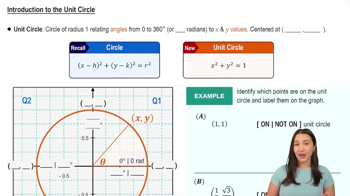
Introduction to the Unit Circle

Cosine Function

The cosine function, denoted as cos(ΞΈ), represents the x-coordinate of a point on the unit circle corresponding to an angle ΞΈ measured from the positive x-axis. For angles measured in radians, such as Ο€/6, the cosine function provides a specific value that can be derived from the coordinates of the corresponding point on the unit circle.
Recommended video:
5:53
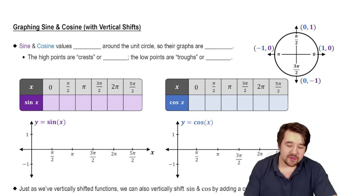
Graph of Sine and Cosine Function

Reference Angles

Reference angles are the acute angles formed by the terminal side of an angle and the x-axis. They are crucial for determining the values of trigonometric functions in different quadrants. For example, the angle Ο€/6 has a reference angle of Ο€/6 itself, which helps in finding its cosine value directly from the unit circle.
Recommended video:
5:31
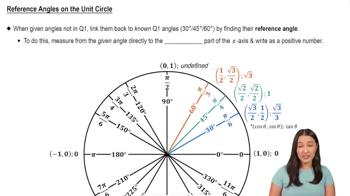
Reference Angles on the Unit Circle
Related Practice
Textbook Question

Use the given triangles to evaluate each expression. If necessary, express the value without a square root in the denominator by rationalizing the denominator.


<IMAGE>


tan πœ‹/3

360
views
Textbook Question

The unit circle has been divided into twelve equal arcs, corresponding to t-values of

0, πœ‹/6, πœ‹/3, πœ‹/2, 2πœ‹/3, 5πœ‹/6, πœ‹, 7πœ‹/6, 4πœ‹/3, 3πœ‹/2, 5πœ‹/3, 11πœ‹/6, and 2πœ‹


Use the (x,y) coordinates in the figure to find the value of each trigonometric function at the indicated real number, t, or state that the expression is undefined.

<IMAGE>


sin 3πœ‹/2

428
views
Textbook Question

In Exercises 5–18, the unit circle has been divided into twelve equal arcs, corresponding to t-values of


0, πœ‹, πœ‹, πœ‹, 2πœ‹, 5πœ‹, πœ‹, 7πœ‹, 4πœ‹, 3πœ‹, 5πœ‹, 11πœ‹, and 2πœ‹.

6 3 2 3 6 6 3 2 3 6


Use the (x,y) coordinates in the figure to find the value of each trigonometric function at the indicated real number, t, or state that the expression is undefined.

<IMAGE>


In Exercises 11–18, continue to refer to the figure at the bottom of the previous page.

sec 3πœ‹/2

373
views
Textbook Question

Use the unit circle shown to find the value of the trigonometric function.

sin (2πœ‹/3)

423
views
Textbook Question

Use the unit circle shown to find the value of the trigonometric function.

tan 11πœ‹/6

596
views
Textbook Question

The unit circle has been divided into eight equal arcs, corresponding to t-values of


0, πœ‹/4, πœ‹/2, 3πœ‹/4, πœ‹, 5πœ‹/4, 3πœ‹/2, 7πœ‹/4, and 2πœ‹.


a. Use the (x,y) coordinates in the figure to find the value of the trigonometric function.

b. Use periodic properties and your answer from part (a) to find the value of the same trigonometric function at the indicated real number.

<IMAGE>


sin 3πœ‹/4

412
views