In Exercises 39–42, use double- and half-angle formulas to find the exact value of each expression. sin 22.5°
Ch. 3 - Trigonometric Identities and Equations

Chapter 3, Problem 3.RE.62
In Exercises 54–67, solve each equation on the interval [0, 2𝝅). Use exact values where possible or give approximate solutions correct to four decimal places. sin 2x = √ 3 sin x
Verified step by step guidance1
Start by rewriting the given equation: \(\sin 2x = \sqrt{3} \sin x\).
Use the double-angle identity for sine: \(\sin 2x = 2 \sin x \cos x\). Substitute this into the equation to get \(2 \sin x \cos x = \sqrt{3} \sin x\).
Bring all terms to one side: \(2 \sin x \cos x - \sqrt{3} \sin x = 0\). Factor out \(\sin x\): \(\sin x (2 \cos x - \sqrt{3}) = 0\).
Set each factor equal to zero and solve separately:
1) \(\sin x = 0\)
2) \(2 \cos x - \sqrt{3} = 0\).
For \(\sin x = 0\), find all \(x\) in \([0, 2\pi)\) where sine is zero. For \(2 \cos x - \sqrt{3} = 0\), solve for \(\cos x = \frac{\sqrt{3}}{2}\) and find all \(x\) in \([0, 2\pi)\) that satisfy this.

Verified video answer for a similar problem:
This video solution was recommended by our tutors as helpful for the problem above.
Video duration:
7mKey Concepts
Here are the essential concepts you must grasp in order to answer the question correctly.
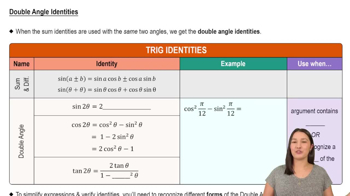
Double-Angle Identity for Sine
The double-angle identity expresses sin(2x) as 2 sin(x) cos(x). This allows rewriting the equation sin 2x = √3 sin x into a form involving sin(x) and cos(x), facilitating algebraic manipulation and solution finding.
Recommended video:
Guided course
Double Angle Identities
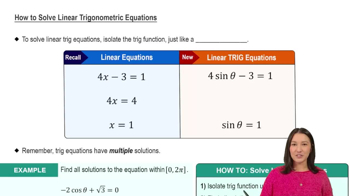
Solving Trigonometric Equations
Solving trigonometric equations involves isolating the trigonometric function and finding all angle solutions within the given interval. It often requires factoring, using identities, and considering the periodic nature of sine and cosine functions.
Recommended video:
Guided course
How to Solve Linear Trigonometric Equations
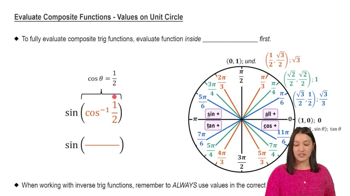
Interval Restriction and Exact Values
Solutions must be found within the interval [0, 2π), meaning all valid angles between 0 and 2π are considered. Using exact values (like π/3, π/6) is preferred, but approximate decimal values to four decimal places are acceptable when exact forms are complex.
Recommended video:
Guided course
Evaluate Composite Functions - Values on Unit Circle
Related Practice
Textbook Question
729
views
Textbook Question
In Exercises 35–38, find the exact value of the following under the given conditions:
b. cos(α﹣β)
sin α = -1/3, 𝝅 < α < 3𝝅/2, and cos β = -1/3, 𝝅 < β < 3𝝅/2.
992
views
Textbook Question
In Exercises 54–67, solve each equation on the interval [0, 2𝝅). Use exact values where possible or give approximate solutions correct to four decimal places. cos 2x = -1
527
views
Textbook Question
In Exercises 35–38, find the exact value of the following under the given conditions:
a. sin(α + β)
sin α = 3/5, 0 < α < 𝝅/2, and sin β = 12/13, 𝝅/2 < β < 𝝅.
783
views
Textbook Question
In Exercises 35–38, find the exact value of the following under the given conditions: b. cos(α﹣β)
sin α = 3/5, 0 < α < 𝝅/2, and sin β = 12/13, 𝝅/2 < β < 𝝅.
944
views
Textbook Question
In Exercises 50–53, find all solutions of each equation. cos x = ﹣1/2
485
views