
Textbook Question
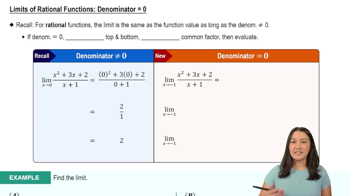
Limits of Rational Functions
In Exercises 13–22, find the limit of each rational function (a) as x → ∞ and (b) as x → −∞. Write ∞ or −∞ where appropriate.
f(x) = (x + 1)/(x² + 3)
365
views

 Verified step by step guidance
 06:11
06:11
 05:43
05:43 05:36
05:36Limits of Rational Functions
In Exercises 13–22, find the limit of each rational function (a) as x → ∞ and (b) as x → −∞. Write ∞ or −∞ where appropriate.
f(x) = (x + 1)/(x² + 3)
Finding Limits of Differences When x → ±∞
Find the limits in Exercises 84–90. (Hint: Try multiplying and dividing by the conjugate.)
lim x → ∞ (√(x + 9) − √(x + 4))
Calculating Limits
Find the limits in Exercises 11–22.
limx→−1/2 4x(3x+4)²
Use the Intermediate Value Theorem in Exercises 69–74 to prove that each equation has a solution. Then use a graphing calculator or computer grapher to solve the equations.
x³ − 15x + 1 = 0 (three roots)
Limits and Infinity
Find the limits in Exercises 37–46.
x²/³ + x⁻¹
lim --------------------
x→∞ x²/³ + cos²x
Finding Limits
In Exercises 3–8, find the limit of each function (a) as x → ∞ and (b) as x → −∞. (You may wish to visualize your answer with a graphing calculator or computer.)
f(x) = 2/x − 3