
Ch. 1 - Functions
Hass - Thomas' Calculus 15th Edition
Hass15th EditionThomas' CalculusISBN: 9780137616077Not the one you use?Change textbook
Chapter 1, Problem 1.4

A hot-air balloon rising straight up from a level field is tracked by a range finder located 500 ft from the point of liftoff. Express the balloon’s height as a function of the angle the line from the range finder to the balloon makes with the ground.

Verified step by step guidance
1
Consider the right triangle formed by the balloon, the range finder, and the point on the ground directly below the balloon. The balloon's height is the opposite side, the distance from the range finder to the point of liftoff is the adjacent side, and the line from the range finder to the balloon is the hypotenuse.
Let \( \theta \) be the angle between the ground and the line from the range finder to the balloon. We need to express the balloon's height \( h \) as a function of \( \theta \).
Use the tangent function, which relates the opposite side to the adjacent side in a right triangle: \( \tan(\theta) = \frac{\text{opposite}}{\text{adjacent}} = \frac{h}{500} \).
Solve for \( h \) in terms of \( \theta \): \( h = 500 \cdot \tan(\theta) \).
Thus, the balloon's height as a function of the angle \( \theta \) is \( h(\theta) = 500 \cdot \tan(\theta) \).

Verified video answer for a similar problem:

This video solution was recommended by our tutors as helpful for the problem above.
Video duration:
3m
Was this helpful?

Key Concepts

Here are the essential concepts you must grasp in order to answer the question correctly.

Trigonometric Functions

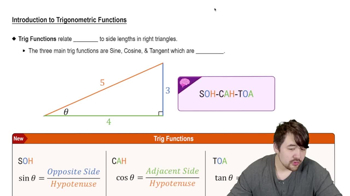
Trigonometric functions, such as sine, cosine, and tangent, relate the angles of a triangle to the lengths of its sides. In this context, the height of the balloon can be expressed using the tangent function, which connects the angle of elevation from the range finder to the height of the balloon and the horizontal distance from the range finder to the point of liftoff.
Recommended video:
6:04
Introduction to Trigonometric Functions

Right Triangle Relationships

The scenario involves a right triangle formed by the height of the balloon, the horizontal distance from the range finder to the liftoff point, and the line of sight to the balloon. Understanding the properties of right triangles is essential for applying trigonometric ratios to find the height of the balloon as a function of the angle of elevation.
Recommended video:
05:59
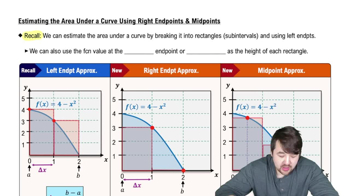
Estimating the Area Under a Curve with Right Endpoints & Midpoint

Function Representation

In calculus, expressing one quantity as a function of another is fundamental. Here, the height of the balloon is represented as a function of the angle of elevation, allowing for the analysis of how changes in the angle affect the height. This relationship can be modeled mathematically, facilitating further exploration of the balloon's motion.
Recommended video:
06:21
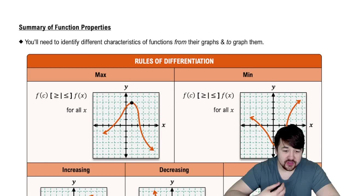
Properties of Functions
Related Practice
Textbook Question

Composition of Functions


A balloon’s volume V is given by V = s² + 2s + 3 cm³, where s is the ambient temperature in °C. The ambient temperature s at time t minutes is given by s = 2t − 3 °C. Write the balloon’s volume V as a function of time t.

206
views
Textbook Question

Finding a Viewing Window


In Exercises 5–30, find an appropriate graphing software viewing window for the given function and use it to display that function’s graph. The window should give a picture of the overall behavior of the function. There is more than one choice, but incorrect choices can miss important aspects of the function.


y = 3 cos 60x

196
views
Textbook Question

Graphing


In Exercises 69–76, graph each function not by plotting points, but by starting with the graph of one of the standard functions presented in Figures 1.14–1.17 and applying an appropriate transformation.


y = (−2x)²/³

202
views
Textbook Question

Radians and Degrees


On a circle of radius 10 m, how long is an arc that subtends a central angle of (a) 4π/5 radians? (b) 110°?

259
views
Textbook Question

Finding a Viewing Window


In Exercises 5–30, find an appropriate graphing software viewing window for the given function and use it to display that function’s graph. The window should give a picture of the overall behavior of the function. There is more than one choice, but incorrect choices can miss important aspects of the function.


f(x) = (x² − 1)/(x² + 1)

270
views
Textbook Question

Finding Formulas for Functions


A point P in the first quadrant lies on the graph of the function f(x) = √x. Express the coordinates of P as functions of the slope of the line joining P to the origin.

362
views