In Exercises 1–10, perform the indicated operations and write the result in standard form. (7 + 8i)(7 − 8i)
Ch. 5 - Complex Numbers, Polar Coordinates and Parametric Equations

All textbooks
Blitzer 3rd Edition
Ch. 5 - Complex Numbers, Polar Coordinates and Parametric Equations
Problem 5
Blitzer 3rd Edition
Ch. 5 - Complex Numbers, Polar Coordinates and Parametric Equations
Problem 5Chapter 5, Problem 5
In Exercises 1–8, add or subtract as indicated and write the result in standard form. 6 − (−5 + 4i) − (−13 − i)
Verified step by step guidance1
Identify the expression to simplify: \(6 - (-5 + 4i) - (-13 - i)\).
Apply the distributive property to remove the parentheses by changing the signs inside each parenthesis preceded by a minus: \(6 + 5 - 4i + 13 + i\).
Group the real parts together and the imaginary parts together: \((6 + 5 + 13) + (-4i + i)\).
Add the real parts: \(6 + 5 + 13\), and add the imaginary parts: \(-4i + i\) separately.
Write the final expression in standard form \(a + bi\), where \(a\) is the sum of the real parts and \(b\) is the sum of the imaginary parts.

Verified video answer for a similar problem:
This video solution was recommended by our tutors as helpful for the problem above.
Video duration:
2mWas this helpful?
Key Concepts
Here are the essential concepts you must grasp in order to answer the question correctly.
Complex Numbers and Standard Form
Complex numbers are expressed in the form a + bi, where a is the real part and b is the imaginary part. Writing a complex number in standard form means presenting it clearly as a sum or difference of its real and imaginary components.
Recommended video:
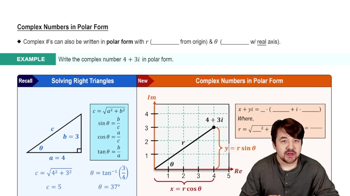
Complex Numbers In Polar Form
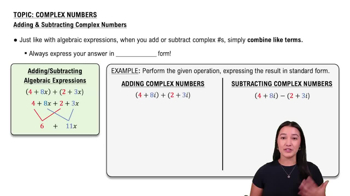
Addition and Subtraction of Complex Numbers
To add or subtract complex numbers, combine their real parts separately and their imaginary parts separately. This process is similar to combining like terms in algebra, ensuring the result remains in standard form.
Recommended video:
Adding and Subtracting Complex Numbers
Handling Negative Signs and Parentheses
When subtracting complex numbers, carefully distribute the negative sign across all terms inside the parentheses. This step is crucial to avoid sign errors and correctly simplify the expression.
Recommended video:
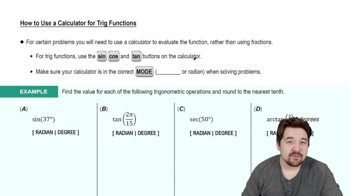
How to Use a Calculator for Trig Functions
Related Practice
Textbook Question
676
views
Textbook Question
In Exercises 59–74, convert each polar equation to a rectangular equation. Then use a rectangular coordinate system to graph the rectangular equation. r = 8
866
views
Textbook Question
In Exercises 53–64, use DeMoivre's Theorem to find the indicated power of the complex number. Write answers in rectangular form. (1 + i)⁵
571
views
Textbook Question
In Exercises 29–36, simplify and write the result in standard form.
√3² − 4 ⋅ 2 ⋅ 5
469
views
Textbook Question
In Exercises 53–64, use DeMoivre's Theorem to find the indicated power of the complex number. Write answers in rectangular form. [1/2 (cos π/12 + i sin π/12)]⁶
606
views
Textbook Question
In Exercises 53–58, perform the indicated operation(s) and write the result in standard form. ___ ___ 5√(−16) + 3√(−81)
715
views