Ch. 4 - Laws of Sines and Cosines; Vectors
Blitzer - Trigonometry 3rd Edition
Blitzer3rd EditionTrigonometryISBN: 9780137316601Not the one you use?Change textbook
Chapter 4, Problem 4b

In Exercises 1–4, u and v have the same direction. In each exercise: Find ||v||.
Graph showing points (-21, 10) and (-21, -20) with a vector b between them.

Verified step by step guidance
1
Identify the coordinates of the points given in the vector. Here, the vector \( \mathbf{b} \) starts at \((-21, 10)\) and ends at \((-21, -20)\).
Calculate the components of the vector \( \mathbf{b} \) by subtracting the coordinates of the initial point from the terminal point: \( \mathbf{b} = (-21 - (-21), -20 - 10) = (0, -30) \).
Since vectors \( \mathbf{u} \) and \( \mathbf{v} \) have the same direction, the magnitude of \( \mathbf{v} \) can be found by calculating the length of \( \mathbf{b} \), which is the magnitude of the vector between the two points.
Use the distance formula (or magnitude formula for vectors) to find the length of \( \mathbf{b} \): \[ ||\mathbf{b}|| = \sqrt{(0)^2 + (-30)^2} \].
Simplify the expression to find the magnitude \( ||\mathbf{b}|| \), which is the same as \( ||\mathbf{v}|| \) since they have the same direction.

Verified video answer for a similar problem:

This video solution was recommended by our tutors as helpful for the problem above.
Video duration:
3m
Was this helpful?

Key Concepts

Here are the essential concepts you must grasp in order to answer the question correctly.

Vector Magnitude (Norm)

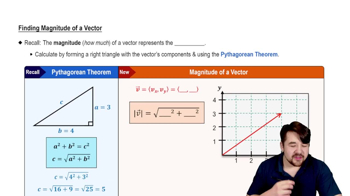
The magnitude or norm of a vector is the length of the vector in the coordinate plane. It is calculated using the distance formula derived from the Pythagorean theorem, which for a vector with components (x, y) is ||v|| = √(x² + y²). This represents the straight-line distance from the origin to the point (x, y).
Recommended video:
04:44
Finding Magnitude of a Vector

Vector Direction and Components

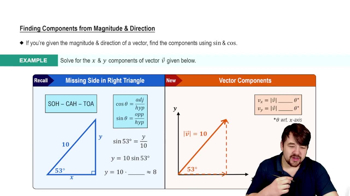
A vector's direction is determined by the angle it makes with the coordinate axes, and its components represent its projection along these axes. When two vectors have the same direction, one is a scalar multiple of the other, meaning their components are proportional. Understanding this helps in relating vectors u and v in the problem.
Recommended video:
04:55
Finding Components from Direction and Magnitude

Using Coordinates to Find Vector Components

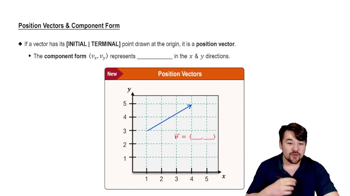
Vectors can be represented by points in the plane, where the vector from point A to point B is found by subtracting coordinates: (x2 - x1, y2 - y1). This allows calculation of the vector's components, which are essential for finding its magnitude and direction.
Recommended video:
03:55
Position Vectors & Component Form