Class I MHC molecules display_____antigens and activate_____cells. Class II MHC molecules display _____antigens and activate_____cells.
Verified step by step guidance
1
Step 1: Understand the role of MHC (Major Histocompatibility Complex) molecules. MHC molecules are proteins found on the surface of cells that play a critical role in the immune system by presenting antigens to immune cells.
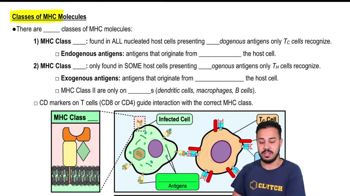
Step 2: Learn the distinction between Class I and Class II MHC molecules. Class I MHC molecules are found on all nucleated cells, while Class II MHC molecules are primarily found on antigen-presenting cells such as macrophages, dendritic cells, and B cells.
Step 3: Identify the type of antigens displayed by each class. Class I MHC molecules present endogenous antigens (antigens originating from within the cell, such as viral or tumor antigens), while Class II MHC molecules present exogenous antigens (antigens originating outside the cell, such as bacterial or extracellular pathogens).
Step 4: Determine the type of immune cells activated by each class. Class I MHC molecules activate cytotoxic T cells (CD8+ T cells), which are responsible for killing infected or abnormal cells. Class II MHC molecules activate helper T cells (CD4+ T cells), which assist in coordinating the immune response.
Step 5: Combine the information to understand the complete mechanism: Class I MHC molecules display endogenous antigens and activate cytotoxic T cells, while Class II MHC molecules display exogenous antigens and activate helper T cells.
Verified video answer for a similar problem:
This video solution was recommended by our tutors as helpful for the problem above
Play a video:
Was this helpful?
Key Concepts
Here are the essential concepts you must grasp in order to answer the question correctly.
Class I MHC Molecules
Class I Major Histocompatibility Complex (MHC) molecules are proteins found on the surface of nearly all nucleated cells. They present endogenous antigens, which are typically derived from proteins synthesized within the cell, to CD8+ cytotoxic T cells. This process is crucial for the immune system to recognize and eliminate infected or malignant cells.
Class II MHC molecules are primarily expressed on professional antigen-presenting cells, such as dendritic cells, macrophages, and B cells. They present exogenous antigens, which are derived from extracellular sources, to CD4+ helper T cells. This interaction is essential for the activation of helper T cells, which in turn assist in orchestrating the immune response.
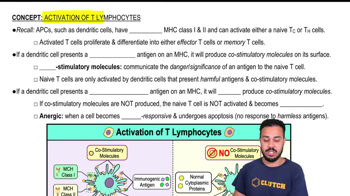
T cell activation is a critical process in the adaptive immune response, involving the recognition of specific antigens presented by MHC molecules. For CD8+ T cells, activation requires the recognition of Class I MHC-antigen complexes, while CD4+ T cells require Class II MHC-antigen complexes. This activation leads to T cell proliferation, differentiation, and the execution of immune functions, such as killing infected cells or helping other immune cells.