
Textbook Question
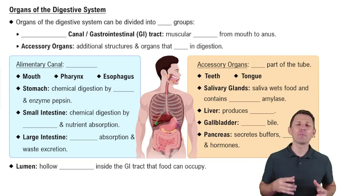
Name the six functional activities of the digestive system.
1203
views
1
rank

 Verified step by step guidance
 02:50
02:50
 6:28
6:28 4:40
4:40Name the six functional activities of the digestive system.
Trace the path of a single protein molecule that has been ingested.
The protein molecule must be digested before it can be transported to and utilized by the cells because
a. Protein is only useful directly
b. Protein has a low pH
c. Proteins in the circulating blood produce an adverse osmotic pressure
d. The protein is too large to be readily absorbed
Trace the path of a single protein molecule that has been ingested.
Before the blood carrying the products of protein digestion reaches the heart, it first passes through capillary networks in:
a. The spleen
b. The lungs
c. The liver
d. The brain
Make a simple line drawing of the organs of the alimentary canal and label each organ. Then add three labels to your drawing—salivary glands, liver, and pancreas—and use arrows to show where each of these organs empties its secretions into the alimentary canal.
Someone has eaten a meal of buttered toast, cream, and eggs. Which of the following would you expect to happen?
a. Compared to the period shortly after the meal, gastric motility and secretion of HCl decrease when the food reaches the duodenum
b. Gastric motility increases even as the person is chewing the food (before swallowing)
c. Fat will be emulsified in the duodenum by the action of bile
d. All of these
a. What is the normal number of permanent teeth? Of deciduous teeth?
b. What substance covers the tooth crown? Its root?
c. What substance makes up the bulk of a tooth?
d. What and where is pulp?