Ch. 13 The Peripheral Nervous System
Amerman - Human Anatomy & Physiology 2nd Edition
Amerman2nd EditionHuman Anatomy & PhysiologyISBN: 9780136873822Not the one you use?Change textbook
Chapter 13, Problem 18b

Mark the following statements as true or false. If a statement is false, correct it to make a true statement.
b. Thermoreceptors send temperature information to centers in the hypothalamus.

Verified step by step guidance
1
Step 1: Understand the role of thermoreceptors. Thermoreceptors are specialized sensory receptors that detect changes in temperature and send this information to the central nervous system.
Step 2: Recall the function of the hypothalamus. The hypothalamus is a key regulatory center in the brain responsible for maintaining homeostasis, including temperature regulation.
Step 3: Confirm the pathway of temperature information. Thermoreceptors send signals via sensory neurons to the central nervous system, and the hypothalamus processes this information to regulate body temperature.
Step 4: Evaluate the statement. Based on the above understanding, determine whether the statement 'Thermoreceptors send temperature information to centers in the hypothalamus' is true or false.
Step 5: If the statement is false, correct it. For example, if the statement inaccurately describes the role of thermoreceptors or the hypothalamus, rewrite it to accurately reflect their functions.

Verified video answer for a similar problem:

This video solution was recommended by our tutors as helpful for the problem above.
Was this helpful?

Key Concepts

Here are the essential concepts you must grasp in order to answer the question correctly.

Thermoreceptors

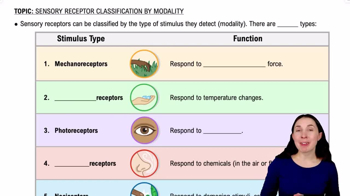
Thermoreceptors are specialized sensory neurons that respond to changes in temperature. They are located throughout the body, particularly in the skin and internal organs, and play a crucial role in thermoregulation by detecting both hot and cold stimuli. This information is essential for maintaining homeostasis and triggering appropriate physiological responses.
Recommended video:
2:11
Sensory Receptor Classification by Modality

Hypothalamus

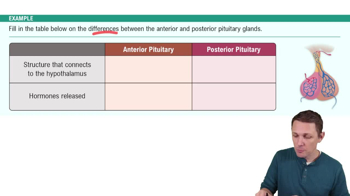
The hypothalamus is a small but vital region of the brain that regulates many bodily functions, including temperature control, hunger, and thirst. It acts as a control center, receiving input from thermoreceptors and other sensory pathways to maintain the body's internal environment. The hypothalamus initiates responses such as sweating or shivering to adjust body temperature.
Recommended video:
Guided course
6:11
The Hypothalamus and Pituitary Gland Example 3

Homeostasis

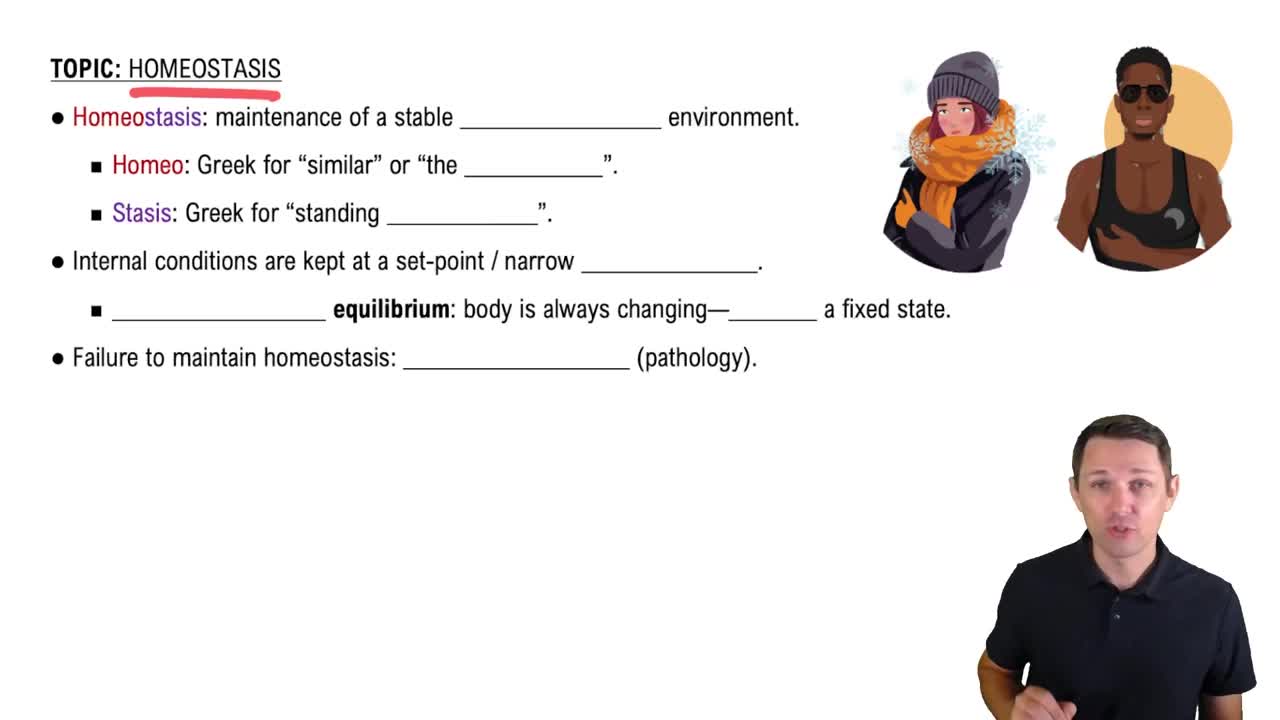
Homeostasis refers to the body's ability to maintain a stable internal environment despite external changes. This involves various physiological processes, including temperature regulation, pH balance, and fluid levels. The interaction between thermoreceptors and the hypothalamus is a key example of how the body achieves homeostasis, ensuring optimal functioning of biological systems.
Recommended video:
Guided course
01:59
Introduction to Homeostasis