Ch. 18 The Cardiovascular System II: The Blood Vessels
Amerman - Human Anatomy & Physiology 2nd Edition
Amerman2nd EditionHuman Anatomy & PhysiologyISBN: 9780136873822Not the one you use?Change textbook
Chapter 18, Problem 9e

Mark the following statements as true or false. If a statement is false, correct it to make a true statement.
The kidneys control blood pressure directly through adjustment of blood volume.

Verified step by step guidance
1
Step 1: Understand the role of the kidneys in regulating blood pressure. The kidneys contribute to blood pressure regulation by controlling blood volume through processes such as filtration, reabsorption, and excretion of water and electrolytes.
Step 2: Analyze the statement provided. The statement claims that the kidneys control blood pressure directly through adjustment of blood volume. Consider whether this is accurate or if there is a more indirect mechanism involved.
Step 3: Recall that the kidneys regulate blood pressure indirectly as well, through the renin-angiotensin-aldosterone system (RAAS). When blood pressure drops, the kidneys release renin, which triggers a cascade leading to vasoconstriction and increased blood volume.
Step 4: Determine whether the statement is true or false based on the information above. If false, correct the statement to reflect the indirect role of the kidneys in blood pressure regulation via RAAS.
Step 5: Rewrite the corrected statement if necessary. For example, 'The kidneys control blood pressure indirectly through adjustment of blood volume and activation of the renin-angiotensin-aldosterone system.'

Verified video answer for a similar problem:

This video solution was recommended by our tutors as helpful for the problem above.
Was this helpful?

Key Concepts

Here are the essential concepts you must grasp in order to answer the question correctly.

Kidney Function in Blood Pressure Regulation

The kidneys play a crucial role in regulating blood pressure by controlling blood volume through the filtration and reabsorption of water and electrolytes. When blood volume increases, blood pressure rises, and vice versa. This process is primarily mediated by the renin-angiotensin-aldosterone system (RAAS), which adjusts blood volume and systemic vascular resistance.
Recommended video:
6:37
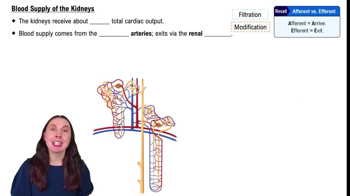
Blood Supply to the Kidneys

Renin-Angiotensin-Aldosterone System (RAAS)

RAAS is a hormone system that regulates blood pressure and fluid balance. When blood pressure drops, the kidneys release renin, which converts angiotensinogen to angiotensin I. Angiotensin I is then converted to angiotensin II, a potent vasoconstrictor that increases blood pressure and stimulates aldosterone release, promoting sodium and water retention to increase blood volume.
Recommended video:
11:30
Renin-Angiotensin-Aldosterone-System

Homeostasis

Homeostasis refers to the body's ability to maintain stable internal conditions despite external changes. In the context of blood pressure, the kidneys contribute to homeostasis by adjusting fluid levels and electrolyte balance, ensuring that blood pressure remains within a normal range. This dynamic balance is essential for overall health and proper organ function.
Recommended video:
Guided course
01:59
Introduction to Homeostasis