Ch. 5 The Integumentary System
Amerman - Human Anatomy & Physiology 2nd Edition
Amerman2nd EditionHuman Anatomy & PhysiologyISBN: 9780136873822Not the one you use?Change textbook
Chapter 5, Problem 1

Explain why the skin is an organ.

Verified step by step guidance
1
Define what an organ is: An organ is a structure composed of two or more types of tissues that work together to perform specific functions.
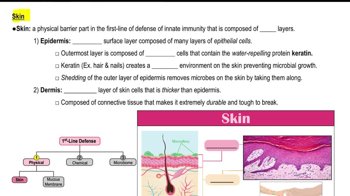
Identify the types of tissues present in the skin: The skin contains epithelial tissue (epidermis), connective tissue (dermis), muscle tissue (arrector pili muscles), and nervous tissue (sensory receptors).
Explain the functions of the skin: The skin performs multiple functions, such as protection against pathogens, regulation of body temperature, sensation, and synthesis of vitamin D.
Highlight the integration of tissues: The various tissues in the skin work together to carry out its functions. For example, sensory receptors in the nervous tissue detect stimuli, while the epithelial tissue provides a protective barrier.
Conclude why the skin qualifies as an organ: Since the skin is composed of multiple tissue types that collaborate to perform essential functions, it meets the criteria of an organ.

Verified video answer for a similar problem:

This video solution was recommended by our tutors as helpful for the problem above.
Was this helpful?

Key Concepts

Here are the essential concepts you must grasp in order to answer the question correctly.

Definition of an Organ

An organ is a collection of tissues that work together to perform specific functions within an organism. In humans, organs are part of organ systems that contribute to overall bodily functions. Understanding this definition is crucial to recognizing how the skin fits into the broader category of organs.
Recommended video:
Guided course
02:22
Levels of Organization Example 1

Structure of the Skin

The skin is composed of multiple layers, including the epidermis, dermis, and subcutaneous tissue, each with distinct functions. This complex structure allows the skin to protect the body, regulate temperature, and provide sensory information. Recognizing the skin's layered architecture is essential for understanding its role as an organ.
Recommended video:
4:08
Skin

Functions of the Skin

The skin serves several vital functions, including protection against pathogens, regulation of body temperature, and sensation. It acts as a barrier to external elements and plays a role in immune response. Understanding these functions highlights the skin's importance as an organ in maintaining homeostasis and overall health.
Recommended video:
4:08
Skin