Ch. 4 Histology
Amerman - Human Anatomy & Physiology 2nd Edition
Amerman2nd EditionHuman Anatomy & PhysiologyISBN: 9780136873822Not the one you use?Change textbook
Chapter 4, Problem 7b

Mark the following statements as true or false. If a statement is false, correct it to make a true statement.
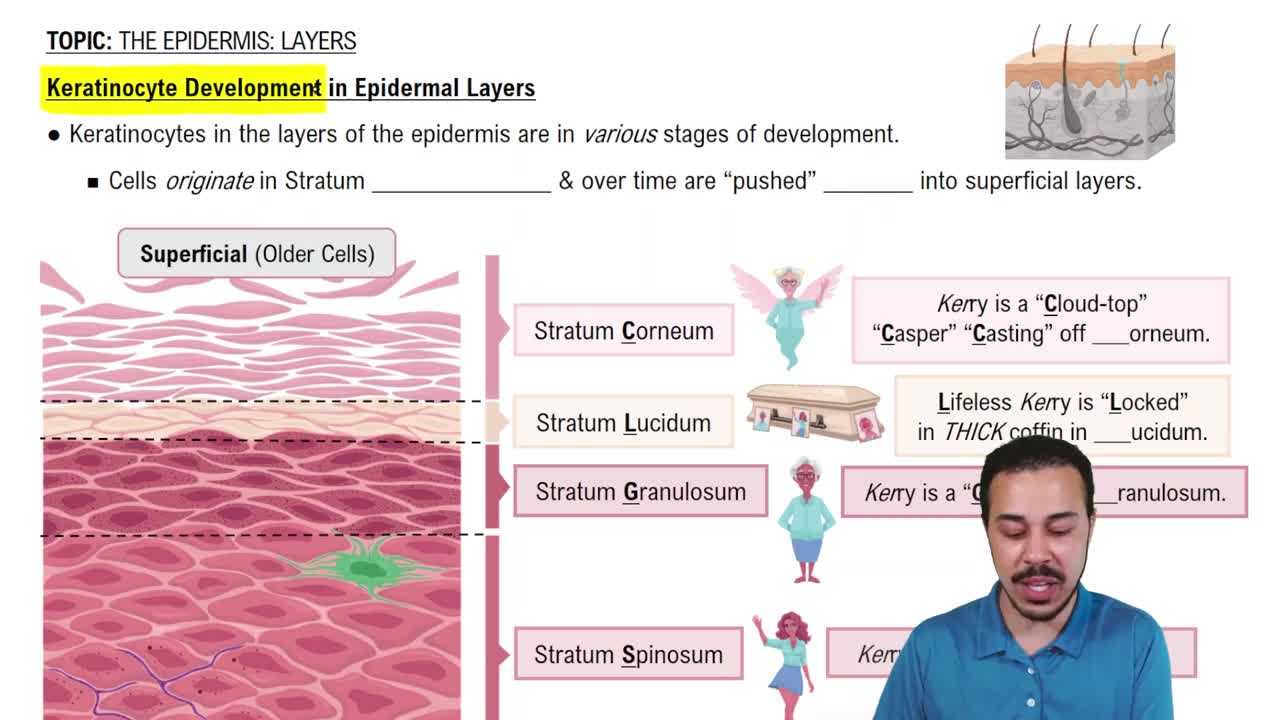
Keratinocytes begin life in the stratum corneum and gradually are pushed into the stratum basale.

Verified step by step guidance
1
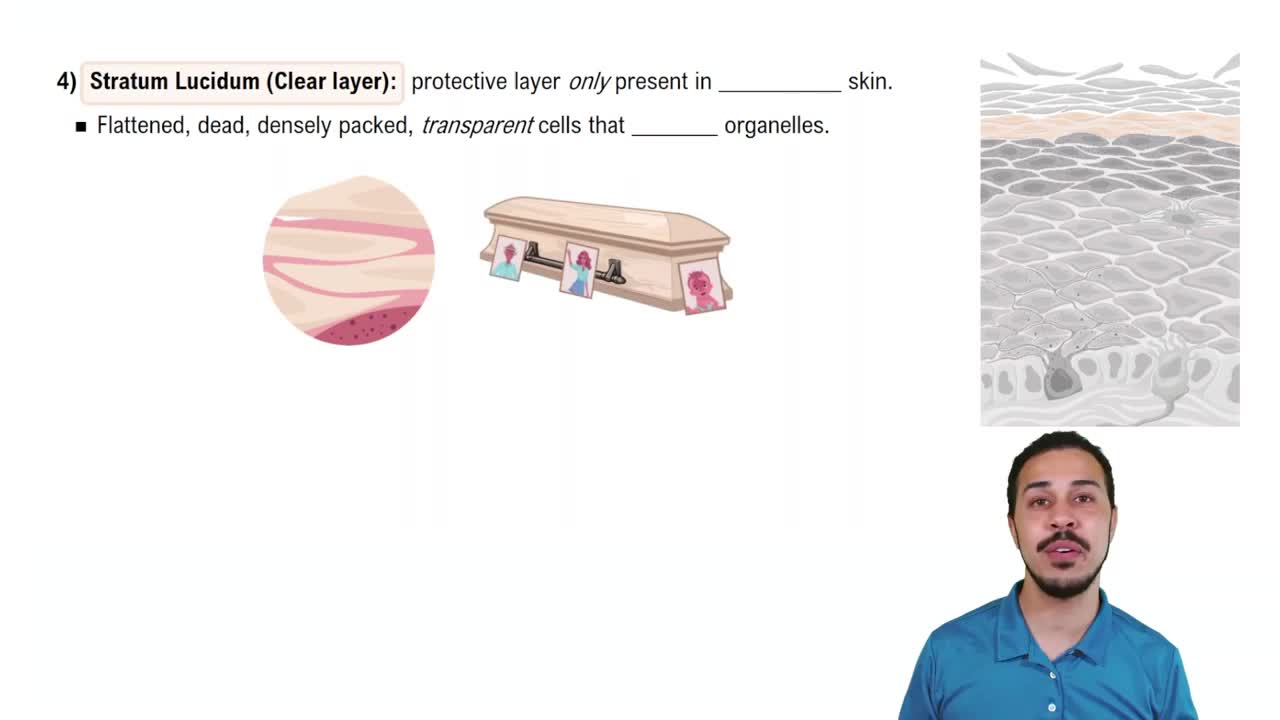
Step 1: Understand the structure of the epidermis, which consists of several layers: stratum basale, stratum spinosum, stratum granulosum, stratum lucidum (only in thick skin), and stratum corneum. Keratinocytes are the primary cells found in the epidermis.
Step 2: Recall the lifecycle of keratinocytes. Keratinocytes originate in the stratum basale, the deepest layer of the epidermis, where they are produced by mitosis of basal cells.
Step 3: Note that keratinocytes gradually move upward through the layers of the epidermis as they mature, undergoing changes in structure and function. They eventually reach the stratum corneum, the outermost layer, where they become flattened, dead cells filled with keratin.
Step 4: Evaluate the statement provided. The claim that keratinocytes begin life in the stratum corneum and are pushed into the stratum basale is incorrect because keratinocytes originate in the stratum basale and move upward toward the stratum corneum.
Step 5: Correct the false statement: 'Keratinocytes begin life in the stratum basale and gradually are pushed into the stratum corneum as they mature.'

Verified video answer for a similar problem:

This video solution was recommended by our tutors as helpful for the problem above.
Was this helpful?

Key Concepts

Here are the essential concepts you must grasp in order to answer the question correctly.

Keratinocyte Development

Keratinocytes are the primary cell type found in the epidermis, the outermost layer of the skin. They originate in the stratum basale, the deepest layer of the epidermis, where they undergo mitosis. As they mature, they migrate upwards through the layers of the epidermis, eventually reaching the stratum corneum, where they become flattened and die, forming a protective barrier.
Recommended video:
07:08
Keratinocyte Development in Epidermal Layers

Epidermal Layers

The epidermis consists of several layers, each with distinct functions. The stratum basale is the bottom layer where new keratinocytes are generated, while the stratum corneum is the outermost layer composed of dead, flattened keratinocytes that provide a tough barrier against environmental damage. Understanding these layers is crucial for comprehending skin biology and the lifecycle of skin cells.
Recommended video:
02:31
Epidermal Layers: Stratum Lucidum (Clear Layer)

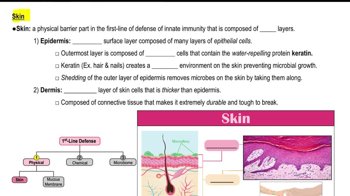
Skin Cell Lifecycle

The lifecycle of skin cells involves a process of proliferation, differentiation, and eventual desquamation. Keratinocytes move from the stratum basale to the stratum corneum over a period of weeks, undergoing changes that prepare them for their role in protecting the skin. This process is essential for maintaining skin health and integrity, as it allows for the continuous renewal of the epidermis.
Recommended video:
4:08
Skin