Ch. 9 The Muscular System
Amerman - Human Anatomy & Physiology 2nd Edition
Erin C. Amerman2nd EditionHuman Anatomy & PhysiologyISBN: 9780136873822Not the one you use?Change textbook
Chapter 9, Problem L2.6

The rectus femoris muscle originates from the anterior superior iliac spine and inserts into the tibial tuberosity. Predict its main actions with only this information.

Verified step by step guidance
1
Identify the origin and insertion points of the rectus femoris muscle. The origin is the anterior superior iliac spine (ASIS), and the insertion is the tibial tuberosity via the patellar tendon.
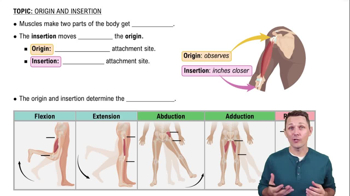
Understand the general principle of muscle action: muscles contract to bring the insertion point closer to the origin. In this case, contraction of the rectus femoris will pull the tibial tuberosity toward the anterior superior iliac spine.
Recognize the anatomical position of the rectus femoris. It crosses both the hip joint and the knee joint, making it a biarticular muscle. This means it can act on both joints.
Determine the actions at the hip joint. Since the muscle originates from the ASIS and crosses the hip joint anteriorly, contraction will result in flexion of the hip (bringing the thigh forward).
Determine the actions at the knee joint. Since the muscle inserts into the tibial tuberosity and crosses the knee joint anteriorly, contraction will result in extension of the knee (straightening the leg).

Verified video answer for a similar problem:

This video solution was recommended by our tutors as helpful for the problem above.
Was this helpful?

Key Concepts

Here are the essential concepts you must grasp in order to answer the question correctly.

Muscle Origin and Insertion

The origin of a muscle is the fixed attachment point, while the insertion is the movable attachment. In the case of the rectus femoris, its origin at the anterior superior iliac spine and insertion at the tibial tuberosity indicates its role in movement. Understanding these points helps predict the muscle's actions during contraction.
Recommended video:
Guided course
5:39
Origin and Insertion

Actions of the Rectus Femoris

The rectus femoris is one of the four quadriceps muscles and primarily functions to extend the knee. Additionally, due to its origin on the pelvis, it also assists in hip flexion. Recognizing these dual actions is essential for predicting how this muscle contributes to movements like walking or running.
Recommended video:
03:53
Action Potential

Knee Extension and Hip Flexion

Knee extension is the straightening of the knee joint, while hip flexion involves lifting the thigh towards the abdomen. The rectus femoris plays a crucial role in both actions, making it vital for activities that require leg movement. Understanding these movements provides insight into the muscle's functional importance in locomotion.
Recommended video:
Guided course
5:39
Origin and Insertion