Ch. 18 The Cardiovascular System: The Heart
Marieb - Human Anatomy & Physiology 7th Edition
Elaine N. Marieb, Katja Hoehn7th EditionHuman Anatomy & PhysiologyISBN: 9780805359091Not the one you use?Change textbook
Chapter 17, Problem 16

Describe the pericardium and distinguish between the fibrous and the serous pericardia relative to histological structure and location.

Verified step by step guidance
1
Begin by defining the pericardium as the double-walled sac that encloses the heart, providing protection and anchoring it within the thoracic cavity.
Explain that the pericardium consists of two main layers: the fibrous pericardium and the serous pericardium, each with distinct histological features and locations.
Describe the fibrous pericardium as the outer layer composed of dense, irregular connective tissue. It is tough and inelastic, serving to protect the heart and prevent overexpansion. It attaches to the diaphragm and the great vessels.
Detail the serous pericardium as the inner layer, which is a thin, double-layered membrane made of simple squamous epithelium (mesothelium) and underlying connective tissue. It has two parts: the parietal layer lining the fibrous pericardium, and the visceral layer (also called the epicardium) covering the heart surface.
Clarify that between the parietal and visceral layers of the serous pericardium is the pericardial cavity, which contains a small amount of lubricating serous fluid to reduce friction during heartbeats.

Verified video answer for a similar problem:

This video solution was recommended by our tutors as helpful for the problem above.
Video duration:
3m
Was this helpful?

Key Concepts

Here are the essential concepts you must grasp in order to answer the question correctly.

Pericardium Overview

The pericardium is a double-walled sac that encloses the heart, providing protection and reducing friction during heartbeats. It consists of two main layers: the fibrous pericardium and the serous pericardium, each with distinct structures and functions.
Recommended video:
4:58
Overview of Renal Physiology

Fibrous Pericardium

The fibrous pericardium is the tough, outer layer made of dense connective tissue. It anchors the heart to surrounding structures like the diaphragm and sternum, preventing overexpansion. Histologically, it is composed mainly of collagen fibers and lacks elasticity.
Recommended video:
Guided course
5:59
Fibrous Layer

Serous Pericardium

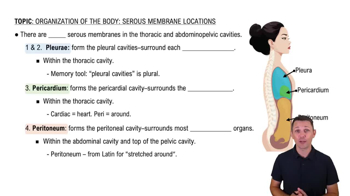
The serous pericardium is a thin, inner layer divided into the parietal and visceral layers. It is composed of a simple squamous mesothelium supported by a thin layer of connective tissue. The space between these layers contains serous fluid, which reduces friction during heart movements.
Recommended video:
Guided course
3:55
Locations of Serous Membranes