
Textbook Question
The myocardium receives its blood supply directly from the:
a. Aorta
b. Coronary arteries
c. Coronary sinus
d. Pulmonary arteries
1463
views

 Verified step by step guidance
 1:42
1:42
 5:59
5:59 7:13
7:13The myocardium receives its blood supply directly from the:
a. Aorta
b. Coronary arteries
c. Coronary sinus
d. Pulmonary arteries
Tracing the blood from the heart to the right hand, we find that blood leaves the heart and passes through the aorta, the right subclavian artery, the axillary and brachial arteries, and through either the radial or ulnar artery to arrive at the hand. Which artery is missing from this sequence?
a. Coronary
b. Brachiocephalic
c. Cephalic
d. Right common carotid
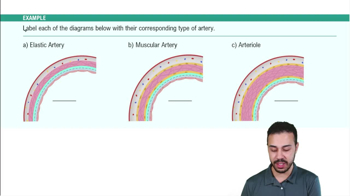
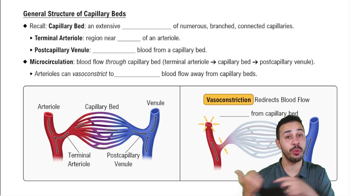
How is the anatomy of capillaries and capillary beds well suited to their function?
Using the letters from column B, match the artery descriptions in column A. (Note that some require more than a single choice.)
Column A
____ (1) unpaired branch of abdominal aorta
____ (2) second branch of aortic arch
____ 3) branch of internal carotid
____ (4) branch of external carotid
____ (5) origin of femoral arteries
Column B
a. right common carotid
b. superior mesenteric
c. left common carotid
d. external iliac
e. inferior mesenteric
f. superficial temporal
g. celiac trunk
h. facial
i. ophthalmic
j. internal iliac
The structure of a capillary wall differs from that of a vein or an artery because
a. it has two tunics instead of three
b. there is less smooth muscle
c. it has a single tunic—only the tunica intima
d. none of these
The baroreceptors in the carotid sinus and aortic arch are sensitive to
a. a decrease in CO₂
b. changes in arterial pressure
c. a decrease in O₂
d. all of these