Pearson+ LogoPearson+ Logo
Ch. 4 Tissue: The Living Fabric
Marieb - Human Anatomy & Physiology 7th Edition
Elaine N. Marieb, Katja Hoehn7th EditionHuman Anatomy & PhysiologyISBN: 9780805359091Not the one you use?Change textbook
Chapter 4, Problem 7

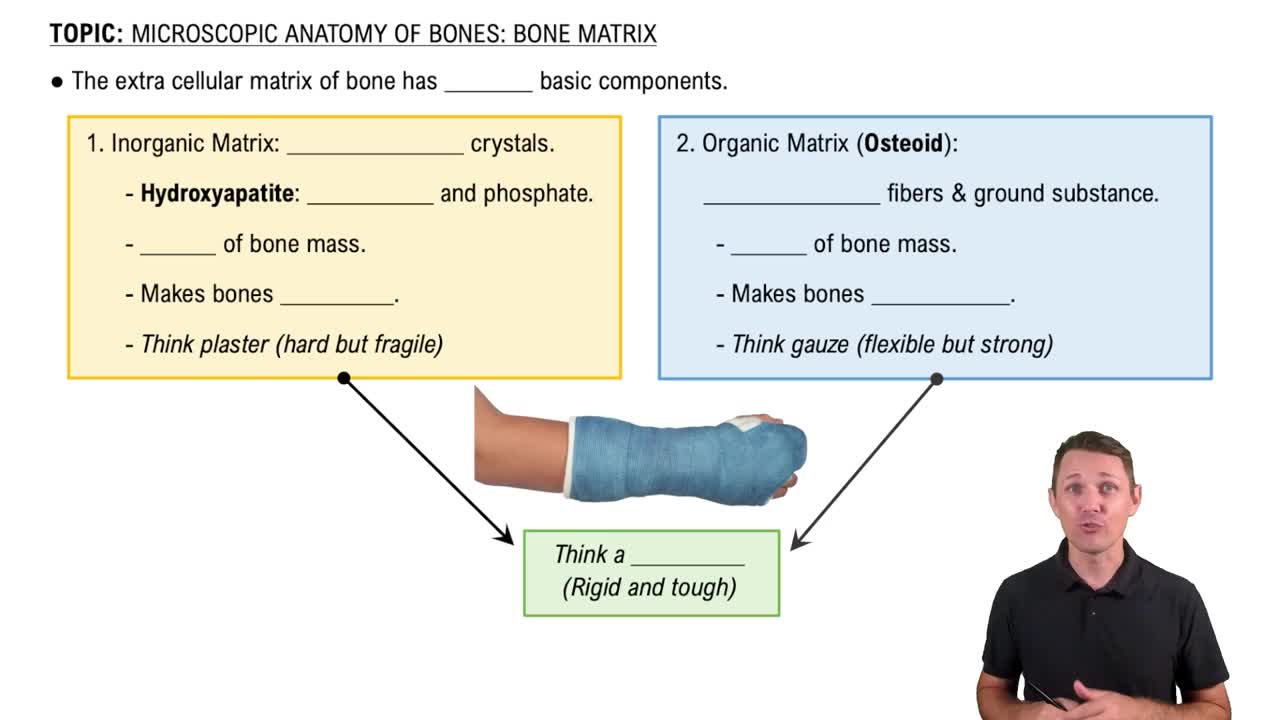
Name the two major components of the extracellular matrix and, if applicable, subclasses of each component.

Verified step by step guidance
1
Identify the two major components of the extracellular matrix (ECM), which are the fibrous proteins and the ground substance.
Explain that the fibrous proteins primarily include collagen fibers, elastic fibers, and reticular fibers, each providing different structural properties to the ECM.
Describe the ground substance as a gel-like material composed mainly of water, proteoglycans, and glycosaminoglycans (GAGs), which fill the space between cells and fibers.
Clarify that proteoglycans are a subclass of the ground substance and consist of a core protein with attached GAG chains, contributing to the ECM's viscosity and resilience.
Summarize that the ECM's two major components are fibrous proteins (collagen, elastic, reticular fibers) and ground substance (proteoglycans and glycosaminoglycans), which together provide structural support and biochemical signaling.

Verified video answer for a similar problem:

This video solution was recommended by our tutors as helpful for the problem above.
Video duration:
1m
Was this helpful?

Key Concepts

Here are the essential concepts you must grasp in order to answer the question correctly.

Extracellular Matrix (ECM)

The extracellular matrix is a complex network of macromolecules surrounding cells, providing structural and biochemical support. It plays a crucial role in tissue integrity, cell signaling, and regulating cellular behavior.
Recommended video:

Major Components of the ECM: Proteins

Proteins in the ECM include fibrous types like collagen, which provides tensile strength, and elastin, which offers elasticity. Other proteins such as fibronectin and laminin help in cell adhesion and signaling.
Recommended video:
Guided course
5:04
Optic Components

Major Components of the ECM: Polysaccharides (Glycosaminoglycans and Proteoglycans)

Polysaccharides in the ECM mainly consist of glycosaminoglycans (GAGs) and proteoglycans. GAGs are long, unbranched chains that attract water, providing hydration and resistance to compression, while proteoglycans are GAGs linked to proteins, contributing to matrix structure and cell communication.
Recommended video:
Guided course
3:07
Optic Components of the Eyeball Example 1