Pearson+ LogoPearson+ Logo
Ch. 7 The Skeleton
Marieb - Human Anatomy & Physiology 7th Edition
Elaine N. Marieb, Katja Hoehn7th EditionHuman Anatomy & PhysiologyISBN: 9780805359091Not the one you use?Change textbook
Chapter 7, Problem 4

What is the function of the intervertebral discs?

Verified step by step guidance
1
Understand that intervertebral discs are structures located between the vertebrae in the spinal column.
Recognize that these discs serve as cushions or shock absorbers to reduce the impact of movements such as walking, running, or jumping on the spine.
Know that each intervertebral disc consists of a tough outer layer called the annulus fibrosus and a gel-like center called the nucleus pulposus, which together allow flexibility and resilience.
Identify that the discs also help maintain the spacing between vertebrae, which is important for the proper functioning of spinal nerves that exit the spinal cord.
Summarize that the primary function of intervertebral discs is to provide shock absorption, allow flexibility, and maintain spinal stability.

Verified video answer for a similar problem:

This video solution was recommended by our tutors as helpful for the problem above.
Video duration:
2m
Was this helpful?

Key Concepts

Here are the essential concepts you must grasp in order to answer the question correctly.

Structure of Intervertebral Discs

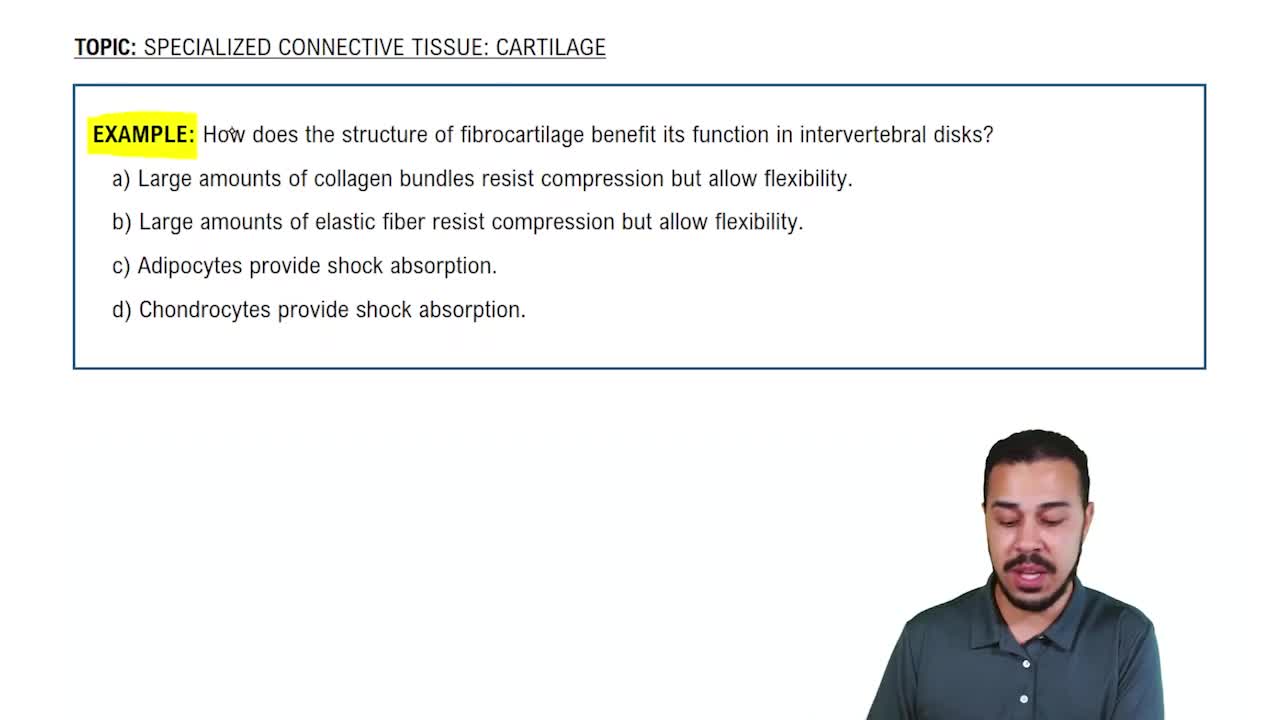
Intervertebral discs are fibrocartilaginous cushions located between adjacent vertebrae in the spine. Each disc consists of a tough outer layer called the annulus fibrosus and a gel-like inner core called the nucleus pulposus, which together provide both strength and flexibility.
Recommended video:
Guided course
6:01
Structure of the Sarcomere: Bands, Zones, Discs & Lines

Shock Absorption

One primary function of intervertebral discs is to absorb and distribute mechanical loads and shocks that occur during activities like walking, running, or lifting. This cushioning effect protects the vertebrae and spinal cord from damage caused by impact and pressure.
Recommended video:
Guided course
02:48
Specialized Connective Tissue: Cartilage Example 3

Facilitation of Spinal Movement

Intervertebral discs allow slight movement between vertebrae, enabling flexibility and mobility of the spine. This permits bending, twisting, and other motions while maintaining the stability and alignment of the vertebral column.
Recommended video:
04:59
Simple and Facilitated Diffusion
Related Practice
Textbook Question

Match the bones in column B with their description in column A. (Note that some descriptions require more than a single choice.)

Column A

_____ (1) connected by the coronal suture

_____ (2) keystone bone of cranium

_____ (3) keystone bone of the face

_____ (4) form the hard palate

_____ (5) allows the spinal cord to pass

_____ (6) forms the chin

_____  (7) contain paranasal sinuses

_____  (8) contains mastoid sinuses

Column B

a. ethmoid

b. frontal

c. mandible

d. maxillary

e. occipital

f. palatine

g. parietal

h. sphenoid

i. temporal

1352
views
Textbook Question

Use key choices to identify the bone descriptions that follow.

Key:

a. carpals

b. femur

c. fibula

d. humerus

e. radius

f. tarsals

g. tibia

h. ulna  

______ (1) articulates with the acetabulum and the tibia     

______ (2) forms the lateral aspect of the ankle     

______ (3) bone that 'carries' the hand     

______ (4) the wrist bones     

______ (5) end shaped like a monkey wrench     

______ (6) articulates with the capitulum of the humerus     

______ (7) largest bone of this 'group' is the calcaneus

776
views
Textbook Question

Which ribs are floating ribs and why are they called that?

1191
views
Textbook Question

How do the relative proportions of the cranium and face of a fetus compare with those of an adult skull?

866
views
Textbook Question

Distinguish between the anulus fibrosus and nucleus pulposus regions of a disc. Which provides durability and strength? Which provides resilience? Which part is involved in a 'slipped' disc?

685
views