Ch. 7 The Skeleton
Marieb - Human Anatomy & Physiology 7th Edition
Marieb, Hoehn7th EditionHuman Anatomy & PhysiologyISBN: 9780805359091Not the one you use?Change textbook
Chapter 7, Problem 3

Use key choices to identify the bone descriptions that follow.
Key:
a. carpals
b. femur
c. fibula
d. humerus
e. radius
f. tarsals
g. tibia
h. ulna  
______ (1) articulates with the acetabulum and the tibia     
______ (2) forms the lateral aspect of the ankle     
______ (3) bone that 'carries' the hand     
______ (4) the wrist bones     
______ (5) end shaped like a monkey wrench     
______ (6) articulates with the capitulum of the humerus     
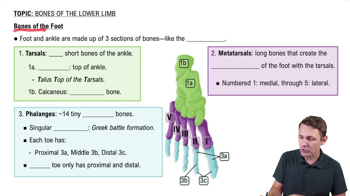
______ (7) largest bone of this 'group' is the calcaneus

Verified step by step guidance
1
Step 1: Identify the bone that articulates with the acetabulum and the tibia. The acetabulum is the socket in the pelvis where the thigh bone fits, so this bone must be the femur (choice b).
Step 2: Determine which bone forms the lateral aspect of the ankle. The lateral ankle is on the outer side of the leg, so this corresponds to the fibula (choice c).
Step 3: Find the bone that 'carries' the hand. The forearm has two bones: radius and ulna. The radius is on the thumb side and directly supports the hand, so this is the radius (choice e).
Step 4: Identify the wrist bones. The wrist is made up of small bones called carpals (choice a).
Step 5: Recognize the bone with an end shaped like a monkey wrench. The ulna has a distinctive hook-like structure called the olecranon, resembling a monkey wrench, so this is the ulna (choice h).

Verified video answer for a similar problem:

This video solution was recommended by our tutors as helpful for the problem above.
Video duration:
1m
Was this helpful?

Key Concepts

Here are the essential concepts you must grasp in order to answer the question correctly.

Bone Articulation

Bone articulation refers to the connection points where two or more bones meet, allowing movement or providing structural support. Understanding which bones articulate with others helps identify their location and function, such as the femur articulating with the acetabulum and tibia in the leg.
Recommended video:
Guided course
5:07
Bones of the Foot

Anatomical Regions and Bone Groups

Bones are grouped based on their anatomical regions, like the carpals and tarsals in the wrist and ankle, respectively. Recognizing these groups aids in identifying bones by their location and function, such as carpals forming the wrist and tarsals forming the ankle.
Recommended video:
06:04
Functional Groups

Bone Shape and Function

The shape of a bone often relates to its function, such as the femur being a long bone that supports weight, or the ulna having a distinctive end shaped like a monkey wrench for articulation. Identifying unique shapes helps distinguish bones and understand their roles in the skeletal system.
Recommended video:
Guided course
2:21
Microscopic Anatomy of Bones - Bone Cells Example 1