Ch. 6 Bones and Bone Structure
Martini - Fundamentals of Anatomy & Physiology 12th Edition
Martini, Nath, Bartholomew12th EditionFundamentals of Anatomy & PhysiologyISBN: 9780137854011Not the one you use?Change textbook
Chapter 6, Problem 14

What is the primary difference between endochondral ossification and intramembranous ossification?

Verified step by step guidance
1
Step 1: Understand the definition of ossification, which is the process of bone formation in the body.
Step 2: Identify that endochondral ossification involves the replacement of a cartilage template with bone, typically forming long bones like the femur and humerus.
Step 3: Recognize that intramembranous ossification involves the direct formation of bone from mesenchymal (undifferentiated) connective tissue without a cartilage stage, commonly forming flat bones such as those of the skull and clavicle.
Step 4: Compare the two processes by noting that endochondral ossification uses a cartilage model as a precursor, while intramembranous ossification does not involve cartilage at any stage.
Step 5: Summarize that the primary difference lies in the presence or absence of a cartilage template during the bone formation process.

Verified video answer for a similar problem:

This video solution was recommended by our tutors as helpful for the problem above.
Video duration:
2m

Key Concepts

Here are the essential concepts you must grasp in order to answer the question correctly.

Endochondral Ossification

Endochondral ossification is the process where bone develops by replacing a cartilage template. It is essential for forming long bones like the femur and involves the gradual calcification and breakdown of cartilage, which is then replaced by bone tissue.
Recommended video:
Guided course
02:23
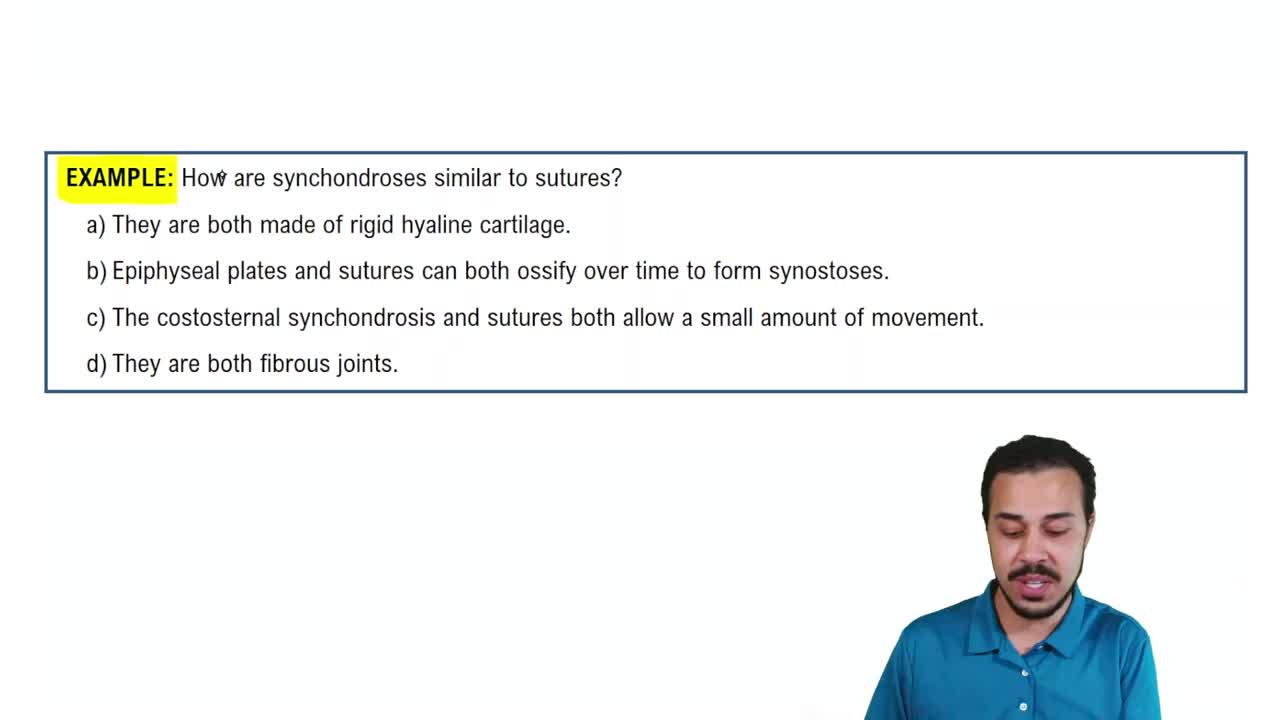
Structural Class: Cartilaginous Joints Example 1

Intramembranous Ossification

Intramembranous ossification is the direct formation of bone from mesenchymal connective tissue without a cartilage stage. This process primarily forms flat bones such as those in the skull and clavicle, where bone cells differentiate directly from mesenchymal cells.
Recommended video:
Guided course
02:23
Structural Class: Cartilaginous Joints Example 1

Primary Difference Between the Two Processes

The main difference lies in the presence or absence of a cartilage model: endochondral ossification uses a cartilage template as a precursor to bone, while intramembranous ossification forms bone directly from mesenchymal tissue. This distinction affects the types of bones formed and their developmental pathways.
Recommended video:
03:04
The Difference Between Anatomy and Physiology