Pearson+ LogoPearson+ Logo
Ch. 13 - Understanding Race
Belk, Maier - Biology: Science for Life 6th Edition
Belk, Maier6th EditionBiology: Science for LifeISBN: 9780135214084Not the one you use?Change textbook
Chapter 13, Problem 7

The biological definition of 'race' corresponds to all of the following except:
a. The genealogical species concept
b. The idea that subgroups within the same species can be distinguished from each other by ancestry
c. There is a natural hierarchy of groups within a species from 'lowest' to 'highest' forms
d. It should be possible to identify races on the basis of shared allele frequencies among populations
e. Races within a species are not reproductively isolated from each other.

Verified step by step guidance
1
Step 1: Begin by understanding the biological definition of 'race.' In biology, 'race' often refers to subpopulations within a species that share certain genetic traits or allele frequencies due to common ancestry. These groups are not reproductively isolated and can interbreed freely.
Step 2: Analyze each option provided in the question. For example, the genealogical species concept (option a) refers to defining species based on shared ancestry, which aligns with the idea of subgroups within a species.
Step 3: Consider the idea of shared allele frequencies (option d). This is a key concept in population genetics and is consistent with the biological understanding of race, as allele frequencies can vary among populations.
Step 4: Evaluate the concept of a natural hierarchy (option c). This idea is not supported by modern biology, as there is no scientific basis for ranking groups within a species as 'higher' or 'lower.' This concept is more aligned with outdated and non-scientific views.
Step 5: Confirm that races within a species are not reproductively isolated (option e). This is consistent with the biological definition, as subgroups within a species can interbreed. Based on this analysis, identify the option that does not align with the biological definition of 'race.'

Verified video answer for a similar problem:

This video solution was recommended by our tutors as helpful for the problem above.
Video duration:
1m
Was this helpful?

Key Concepts

Here are the essential concepts you must grasp in order to answer the question correctly.

Genealogical Species Concept

The genealogical species concept defines a species based on the evolutionary history and lineage of organisms. It emphasizes the importance of ancestry and genetic relationships, suggesting that species are groups of organisms that share a common ancestor. This concept is crucial for understanding how races or subgroups within a species can be identified based on their genealogical ties.
Recommended video:
03:24
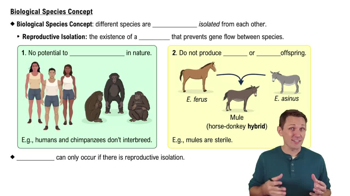
Biological Species Concept

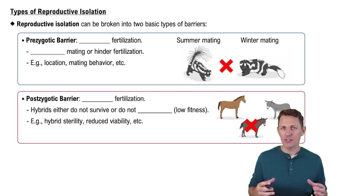
Reproductive Isolation

Reproductive isolation refers to mechanisms that prevent different species or populations from interbreeding, thus maintaining distinct species. In the context of races within a species, it implies that while races may exhibit genetic differences, they are not completely isolated from one another in terms of reproduction. This concept is essential for understanding the dynamics of gene flow and genetic diversity within populations.
Recommended video:
02:47
Types of Reproductive Isolation

Allele Frequencies

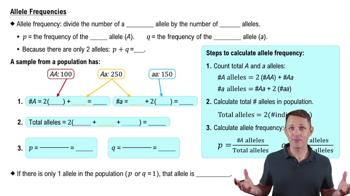
Allele frequencies represent how common a particular allele is within a population. They are used to study genetic variation and can help identify subgroups or races based on shared genetic traits. Understanding allele frequencies is vital for analyzing population genetics and determining how different populations may be distinguished from one another based on their genetic makeup.
Recommended video:
06:36
Allele Frequencies
Related Practice
Textbook Question

Which of the following is an example of a prefertilization barrier to reproduction?

a. A female mammal is unable to carry a hybrid offspring to term

b. Hybrid plants produce only sterile pollen

c. A hybrid between two bird species cannot perform a mating display

d. A male fly of one species performs a 'wing-waving' display that does not convince a female of another species to mate with him

e. A hybrid embryo is not able to complete development

1118
views
Textbook Question

According to the most accepted scientific hypothesis about the origin of two new species from a single common ancestor, most new species arise when

a. Many mutations occur

b. Populations of the ancestral species are isolated from one another

c. There is no natural selection

d. A supernatural creator decides that two new species would be preferable to the old one

e. The ancestral species decides to evolve

1003
views
Textbook Question

For two populations of organisms to be considered separate biological species, they must be

a. Reproductively isolated from each other

b. Unable to produce living offspring

c. Physically very different from each other

d. A and C are correct

e. A, B, and C are correct

2934
views
Textbook Question

All of the following statements support the hypothesis that humans cannot be classified into biological races except:

a. There is more genetic diversity within a racial group than average differences between racial groups.

b. Alleles that are common in one population in a racial group may be uncommon in other populations of the same race.

c. Geneticists can use particular SNP alleles to identify the ancestral group(s) of any individual human.

d. There are no alleles found in all members of a given racial group.

e. There is genetic evidence of mixing among human populations occurring thousands of years ago until the present.

968
views
Textbook Question

The similarity in skin color among different human populations appears to be primarily the result of:

a. Natural selection

b. Convergent evolution

c. Which biological race they belong to

d. A and B are correct

e. A, B, and C are correct

926
views
Textbook Question

The tendency of individuals to choose mates who are like themselves is called

a. Natural selection

b. Sexual selection

c. Assortative mating

d. The founder effect

e. Random mating

1225
views