
Textbook Question
Add labels to the figure that follows, which illustrates the three steps required for speciation to occur.
1073
views


 Verified step by step guidance
 02:53
02:53
 02:47
02:47 04:43
04:43Add labels to the figure that follows, which illustrates the three steps required for speciation to occur.
How are hypotheses about the evolutionary relationships among living organisms tested?
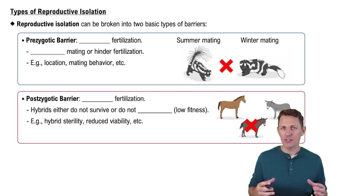
Which of the following is an example of a prefertilization barrier to reproduction?
a. A female mammal is unable to carry a hybrid offspring to term
b. Hybrid plants produce only sterile pollen
c. A hybrid between two bird species cannot perform a mating display
d. A male fly of one species performs a 'wing-waving' display that does not convince a female of another species to mate with him
e. A hybrid embryo is not able to complete development
For two populations of organisms to be considered separate biological species, they must be
a. Reproductively isolated from each other
b. Unable to produce living offspring
c. Physically very different from each other
d. A and C are correct
e. A, B, and C are correct
The biological definition of 'race' corresponds to all of the following except:
a. The genealogical species concept
b. The idea that subgroups within the same species can be distinguished from each other by ancestry
c. There is a natural hierarchy of groups within a species from 'lowest' to 'highest' forms
d. It should be possible to identify races on the basis of shared allele frequencies among populations
e. Races within a species are not reproductively isolated from each other.
All of the following statements support the hypothesis that humans cannot be classified into biological races except:
a. There is more genetic diversity within a racial group than average differences between racial groups.
b. Alleles that are common in one population in a racial group may be uncommon in other populations of the same race.
c. Geneticists can use particular SNP alleles to identify the ancestral group(s) of any individual human.
d. There are no alleles found in all members of a given racial group.
e. There is genetic evidence of mixing among human populations occurring thousands of years ago until the present.