Pearson+ LogoPearson+ Logo
Ch. 13 - Understanding Race
Belk, Maier - Biology: Science for Life 6th Edition
Belk, Maier6th EditionBiology: Science for LifeISBN: 9780135214084Not the one you use?Change textbook
Chapter 13, Problem 3

How are hypotheses about the evolutionary relationships among living organisms tested?

Verified step by step guidance
1
Understand that hypotheses about evolutionary relationships are tested using phylogenetic trees, which are diagrams that represent evolutionary relationships based on shared traits or genetic information.
Collect data on the organisms being studied. This data can include morphological traits (physical characteristics), molecular data (DNA, RNA, or protein sequences), or behavioral traits.
Analyze the data to identify shared derived characteristics (synapomorphies) that indicate common ancestry. For molecular data, align sequences to identify similarities and differences.
Use computational methods, such as maximum parsimony, maximum likelihood, or Bayesian inference, to construct a phylogenetic tree that best fits the data. These methods evaluate different possible trees to find the one that most likely represents the evolutionary relationships.
Test the robustness of the phylogenetic tree by using statistical methods like bootstrapping, which assesses the reliability of the tree's branches, or by comparing the tree to other independent data sets to confirm consistency.

Verified video answer for a similar problem:

This video solution was recommended by our tutors as helpful for the problem above.
Video duration:
1m
Was this helpful?

Key Concepts

Here are the essential concepts you must grasp in order to answer the question correctly.

Phylogenetics

Phylogenetics is the study of evolutionary relationships among biological entities, often using a tree-like diagram called a phylogenetic tree. This approach utilizes genetic, morphological, and behavioral data to infer how species are related through common ancestry. By comparing traits and genetic sequences, scientists can construct hypotheses about the evolutionary pathways that led to the diversity of life.
Recommended video:
04:13
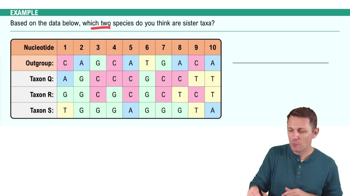
Building Phylogenetic Trees Example 2

Molecular Evidence

Molecular evidence refers to the genetic data obtained from DNA, RNA, and proteins that can be analyzed to determine evolutionary relationships. Techniques such as DNA sequencing allow researchers to compare genetic similarities and differences among organisms. This molecular approach provides a more precise understanding of evolutionary connections than morphological comparisons alone, as it can reveal relationships that are not immediately apparent from physical traits.
Recommended video:
04:49
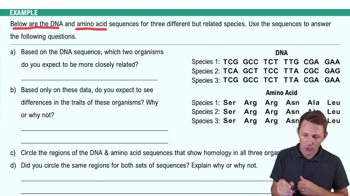
Evidence of Evolution Example 2

Falsifiability in Hypothesis Testing

Falsifiability is a key principle in scientific hypothesis testing, which states that a hypothesis must be testable and able to be proven false. In the context of evolutionary relationships, hypotheses can be evaluated through experiments, observations, and statistical analyses. If new data contradicts a hypothesis, it can be revised or rejected, ensuring that scientific understanding evolves with new evidence.
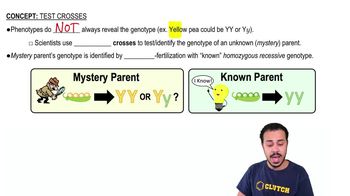
Recommended video: