Pearson+ LogoPearson+ Logo
Ch. 13 - Understanding Race
Belk, Maier - Biology: Science for Life 6th Edition
Belk, Maier6th EditionBiology: Science for LifeISBN: 9780135214084Not the one you use?Change textbook
Chapter 13, Problem 4

Which of the following is an example of a prefertilization barrier to reproduction?
a. A female mammal is unable to carry a hybrid offspring to term
b. Hybrid plants produce only sterile pollen
c. A hybrid between two bird species cannot perform a mating display
d. A male fly of one species performs a 'wing-waving' display that does not convince a female of another species to mate with him
e. A hybrid embryo is not able to complete development

Verified step by step guidance
1
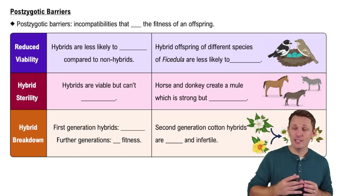
Step 1: Understand the concept of reproductive barriers. Reproductive barriers are mechanisms that prevent species from interbreeding and producing viable offspring. These barriers can be classified into two main types: prefertilization (prezygotic) and postfertilization (postzygotic). Prefertilization barriers occur before the formation of a zygote, while postfertilization barriers occur after fertilization.
Step 2: Analyze the options provided in the question. Each option describes a scenario related to reproduction. Determine whether each scenario occurs before or after fertilization.
Step 3: Evaluate option (a): 'A female mammal is unable to carry a hybrid offspring to term.' This scenario involves a postfertilization barrier because it occurs after fertilization and involves the development of the hybrid offspring.
Step 4: Evaluate option (d): 'A male fly of one species performs a 'wing-waving' display that does not convince a female of another species to mate with him.' This scenario describes a behavioral barrier that prevents mating from occurring, which is a prefertilization barrier.
Step 5: Confirm that option (d) is the correct example of a prefertilization barrier to reproduction, as it prevents the formation of a zygote by inhibiting mating behavior between species.

Verified video answer for a similar problem:

This video solution was recommended by our tutors as helpful for the problem above.
Video duration:
2m
Was this helpful?

Key Concepts

Here are the essential concepts you must grasp in order to answer the question correctly.

Prefertilization Barriers

Prefertilization barriers are mechanisms that prevent mating or fertilization between different species. These barriers can occur before the formation of a zygote and include various forms of reproductive isolation, such as behavioral, temporal, and mechanical isolation. Understanding these barriers is crucial for studying speciation and the maintenance of species boundaries.
Recommended video:
03:28
Postzygotic Barriers

Behavioral Isolation

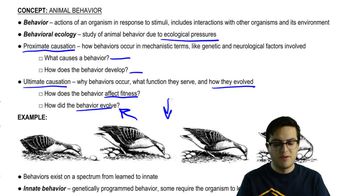
Behavioral isolation is a type of prefertilization barrier where differences in mating behaviors or rituals prevent species from interbreeding. For example, if one species has a specific courtship display that another species does not recognize, they will not mate. This concept highlights the importance of mating signals and behaviors in reproductive success.
Recommended video:

Hybrid Viability and Fertility

Hybrid viability and fertility refer to the ability of hybrid offspring to survive and reproduce. While some hybrids may be born, they can be sterile or have reduced fitness, which limits gene flow between species. This concept is essential for understanding the consequences of hybridization and the evolutionary implications of reproductive barriers.
Recommended video:
04:38
Hybrid Zones
Related Practice
Textbook Question

Define 'biological species.'

1020
views
1
rank
Textbook Question

Add labels to the figure that follows, which illustrates the three steps required for speciation to occur.

1073
views
Textbook Question

How are hypotheses about the evolutionary relationships among living organisms tested?

1359
views
Textbook Question

According to the most accepted scientific hypothesis about the origin of two new species from a single common ancestor, most new species arise when

a. Many mutations occur

b. Populations of the ancestral species are isolated from one another

c. There is no natural selection

d. A supernatural creator decides that two new species would be preferable to the old one

e. The ancestral species decides to evolve

1003
views
Textbook Question

For two populations of organisms to be considered separate biological species, they must be

a. Reproductively isolated from each other

b. Unable to produce living offspring

c. Physically very different from each other

d. A and C are correct

e. A, B, and C are correct

2934
views
Textbook Question

The biological definition of 'race' corresponds to all of the following except:

a. The genealogical species concept

b. The idea that subgroups within the same species can be distinguished from each other by ancestry

c. There is a natural hierarchy of groups within a species from 'lowest' to 'highest' forms

d. It should be possible to identify races on the basis of shared allele frequencies among populations

e. Races within a species are not reproductively isolated from each other.

986
views