Add labels to the figure that follows, which illustrates the predicted pattern of changes in human population growth rates when death rates fall.
Ch. 15 - Is the Human Population Too Large?

Belk, Maier6th EditionBiology: Science for LifeISBN: 9780135214084Not the one you use?Change textbook
Chapter 15, Problem 2
Explain why a decrease in population growth rate is expected as a nonhuman population approaches carrying capacity.
Verified step by step guidance1
Understand the concept of carrying capacity: Carrying capacity, denoted as 'K', is the maximum population size of a species that an environment can sustain indefinitely, given the food, habitat, water, and other necessities available in the environment.
Recognize the role of resources: As the population size increases and approaches the carrying capacity, the availability of resources (such as food and water) begins to decline due to higher consumption rates.
Consider the impact of resource limitation: With fewer resources available per individual, the growth rate of the population begins to slow down. This is because competition for limited resources increases, which can lead to higher mortality rates and lower birth rates.
Apply the logistic growth model: The logistic growth equation, which models population growth, shows this trend mathematically. It is represented as \( \frac{dN}{dt} = rN \left(1 - \frac{N}{K}\right) \), where \(N\) is the population size, \(r\) is the intrinsic rate of increase, and \(K\) is the carrying capacity. As \(N\) approaches \(K\), the term \(\left(1 - \frac{N}{K}\right)\) approaches zero, which in turn causes the growth rate \(\frac{dN}{dt}\) to approach zero.
Acknowledge density-dependent factors: Factors such as predation, disease, and territoriality become more significant as populations grow denser. These density-dependent factors further contribute to the slowing of population growth as it nears the carrying capacity.

Verified video answer for a similar problem:
This video solution was recommended by our tutors as helpful for the problem above.
Video duration:
31sWas this helpful?
Key Concepts
Here are the essential concepts you must grasp in order to answer the question correctly.
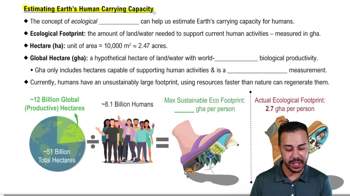
Carrying Capacity
Carrying capacity refers to the maximum number of individuals of a particular species that an environment can sustainably support. It is determined by the availability of resources such as food, water, and habitat space. As a population approaches this limit, the growth rate typically slows due to increased competition for these limited resources.
Recommended video:
Guided course
Estimating Earth’s Human Carrying Capacity
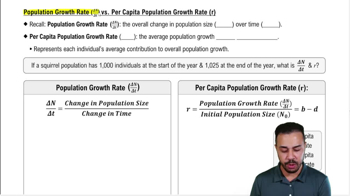
Population Growth Rate
Population growth rate is the rate at which the number of individuals in a population increases over a specific period. It is influenced by factors such as birth rates, death rates, immigration, and emigration. As a population nears its carrying capacity, the growth rate declines due to resource limitations and increased mortality, leading to a more stable population size.
Recommended video:
Guided course
Population Growth Rate vs. Per Capita Population Growth Rate
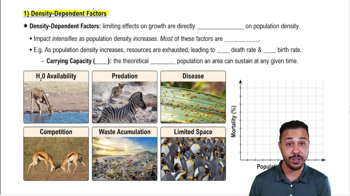
Density-Dependent Factors
Density-dependent factors are environmental influences that affect a population's growth in relation to its density. These include competition for resources, predation, disease, and waste accumulation. As population density increases, these factors become more pronounced, contributing to a decrease in the growth rate as the population approaches carrying capacity.
Recommended video:
Guided course
Density-Dependent Factors
Related Practice
Textbook Question
1207
views
Textbook Question
When individuals in a population are evenly spaced throughout their habitat, their dispersion is termed as__________:
a. Clumped
b. Uniform
c. Random
d. Excessive
e. Exponential
1360
views
Textbook Question
A population growing exponentially
a. Is stable in size
b. Adds a fixed number of individuals every generation
c. Adds a larger number of individuals in each successive generation
d. Will likely expand forever
e. Will not crash
1107
views
Textbook Question
According to the graph shown here, the carrying capacity for fruit flies in the environment of the culture bottle is .
a. 0 flies
b. 100 flies
c. 150 flies
d. Between 100 and 150 flies
e. Impossible to determine
1751
views