
Textbook Question
Explain why a decrease in population growth rate is expected as a nonhuman population approaches carrying capacity.
1480
views


 Verified step by step guidance
 06:24
06:24
 03:01
03:01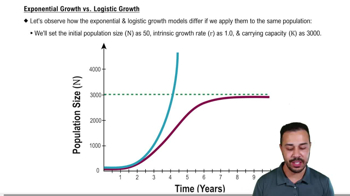 09:46
09:46Explain why a decrease in population growth rate is expected as a nonhuman population approaches carrying capacity.
When individuals in a population are evenly spaced throughout their habitat, their dispersion is termed as__________:
a. Clumped
b. Uniform
c. Random
d. Excessive
e. Exponential
A population growing exponentially
a. Is stable in size
b. Adds a fixed number of individuals every generation
c. Adds a larger number of individuals in each successive generation
d. Will likely expand forever
e. Will not crash
All of the following are density-dependent factors that can influence population size except
a. Weather
b. Food supply
c. Waste concentration in the environment
d. Infectious disease
e. Supply of suitable habitat for survival
In contrast to nonhuman populations, human population growth rates have begun to decline due to
a. Voluntarily increasing death rates
b. Voluntarily decreasing birth rates
c. Involuntary increases in death rates
d. Involuntary decreases in birth rates
e. Density-dependent factors
Populations that rely on stored resources are likely to overshoot the carrying capacity of the environment and consequently experience a(n).
a. Demographic momentum
b. Cultural carrying capacity
c. Decrease in death rates
d. Population crash
e. Exponential growth