Pearson+ LogoPearson+ Logo
Ch. 15 - Is the Human Population Too Large?
Belk, Maier - Biology: Science for Life 6th Edition
Belk, Maier6th EditionBiology: Science for LifeISBN: 9780135214084Not the one you use?Change textbook
Chapter 15, Problem 9

The current carrying capacity of Earth for the human population may have been inflated by
a. Demographic momentum
b. The tendency for women to want to control family size
c. An artificially low number of density-independent factors
d. Our use of fossil fuels
e. Recent population crashes

Verified step by step guidance
1
Step 1: Understand the concept of Earth's carrying capacity. Carrying capacity refers to the maximum number of individuals of a species that an environment can sustainably support, given the available resources such as food, water, and space.
Step 2: Analyze the factors that can influence carrying capacity. These include both density-dependent factors (e.g., competition, predation) and density-independent factors (e.g., natural disasters, climate). Human activities can also artificially alter carrying capacity.
Step 3: Consider the role of fossil fuels. Fossil fuels have allowed humans to increase food production (via mechanized agriculture and fertilizers), improve transportation, and expand resource availability, which can artificially inflate Earth's carrying capacity for humans.
Step 4: Evaluate the other options provided in the question. For example, demographic momentum refers to population growth due to a high proportion of young individuals, which does not directly inflate carrying capacity. Similarly, population crashes and family size control do not artificially increase carrying capacity.
Step 5: Conclude that the use of fossil fuels is the most likely factor that has artificially inflated Earth's carrying capacity for humans, as it has temporarily increased resource availability beyond natural limits.

Verified video answer for a similar problem:

This video solution was recommended by our tutors as helpful for the problem above.
Video duration:
2m
Was this helpful?

Key Concepts

Here are the essential concepts you must grasp in order to answer the question correctly.

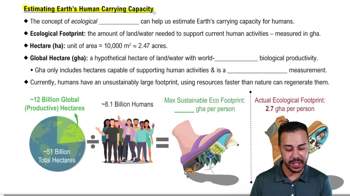
Carrying Capacity

Carrying capacity refers to the maximum number of individuals of a species that an environment can sustainably support without degrading the habitat. For humans, this concept is influenced by resource availability, technology, and consumption patterns. Understanding carrying capacity is crucial for evaluating the sustainability of human populations and their impact on the planet.
Recommended video:
Guided course
06:24
Estimating Earth’s Human Carrying Capacity

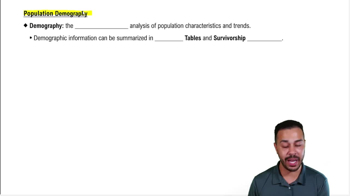
Demographic Momentum

Demographic momentum is the phenomenon where a population continues to grow even after fertility rates decline, due to a large proportion of individuals in reproductive age. This can lead to an inflated perception of carrying capacity, as the population may exceed sustainable limits before stabilizing. Recognizing demographic momentum is essential for understanding population dynamics and future growth projections.
Recommended video:
Guided course
00:43
Population Demography

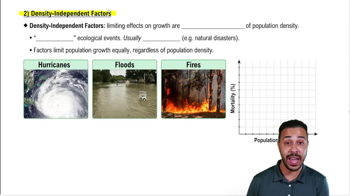
Density-Independent Factors

Density-independent factors are environmental influences that affect population size regardless of the population's density, such as natural disasters, climate change, and resource availability. These factors can significantly impact carrying capacity by altering the environment's ability to support life. Understanding these factors helps in assessing the resilience of human populations in the face of ecological changes.
Recommended video:
Guided course
01:39
Density-Independent Factors