Pearson+ LogoPearson+ Logo
Ch. 15 - Is the Human Population Too Large?
Belk, Maier - Biology: Science for Life 6th Edition
Belk, Maier6th EditionBiology: Science for LifeISBN: 9780135214084Not the one you use?Change textbook
Chapter 15, Problem 6

All of the following are density-dependent factors that can influence population size except
a. Weather
b. Food supply
c. Waste concentration in the environment
d. Infectious disease
e. Supply of suitable habitat for survival

Verified step by step guidance
1
Step 1: Understand the concept of density-dependent factors. These are factors that influence population size based on the population density. Examples include food supply, waste concentration, infectious diseases, and habitat availability.
Step 2: Recognize that density-independent factors, in contrast, affect population size regardless of its density. Weather is a classic example of a density-independent factor because it impacts populations irrespective of their size.
Step 3: Analyze the options provided in the question. Food supply, waste concentration, infectious disease, and habitat availability are all density-dependent factors because their impact increases as population density rises.
Step 4: Identify the exception among the options. Weather does not depend on population density and is therefore a density-independent factor.
Step 5: Conclude that the correct answer is the option that represents a density-independent factor, which is 'weather'.

Verified video answer for a similar problem:

This video solution was recommended by our tutors as helpful for the problem above.
Video duration:
2m
Was this helpful?

Key Concepts

Here are the essential concepts you must grasp in order to answer the question correctly.

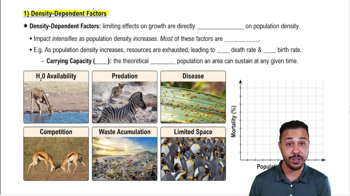
Density-Dependent Factors

Density-dependent factors are environmental influences that affect population size in relation to the population's density. These factors, such as food supply, waste concentration, and disease, become more significant as the population increases, leading to increased competition and mortality rates. Understanding these factors is crucial for analyzing population dynamics and ecological balance.
Recommended video:
Guided course
02:37
Density-Dependent Factors

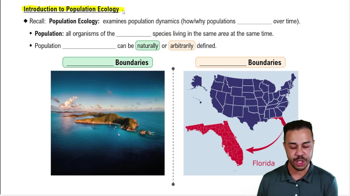
Population Ecology

Population ecology is the study of how populations interact with their environment and how various factors influence their size and distribution. It encompasses concepts such as birth and death rates, carrying capacity, and the effects of biotic and abiotic factors. This field helps in understanding the dynamics of species populations and their responses to environmental changes.
Recommended video:
Guided course
01:17
Population Ecology

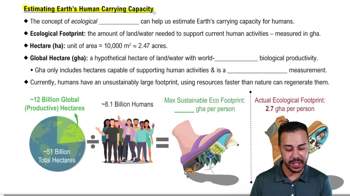
Carrying Capacity

Carrying capacity refers to the maximum number of individuals of a species that an environment can sustainably support. It is determined by the availability of resources such as food, water, and habitat. When a population exceeds its carrying capacity, it can lead to resource depletion, increased mortality, and ultimately a decline in population size, illustrating the importance of density-dependent factors.
Recommended video:
Guided course
06:24
Estimating Earth’s Human Carrying Capacity
Related Practice
Textbook Question

When individuals in a population are evenly spaced throughout their habitat, their dispersion is termed as__________:

a. Clumped

b. Uniform

c. Random

d. Excessive

e. Exponential

1360
views
Textbook Question

A population growing exponentially

a. Is stable in size

b. Adds a fixed number of individuals every generation

c. Adds a larger number of individuals in each successive generation

d. Will likely expand forever

e. Will not crash

1107
views
Textbook Question

According to the graph shown here, the carrying capacity for fruit flies in the environment of the culture bottle is .

a. 0 flies

b. 100 flies

c. 150 flies

d. Between 100 and 150 flies

e. Impossible to determine

1751
views
Textbook Question

In contrast to nonhuman populations, human population growth rates have begun to decline due to

a. Voluntarily increasing death rates

b. Voluntarily decreasing birth rates

c. Involuntary increases in death rates

d. Involuntary decreases in birth rates

e. Density-dependent factors

1217
views
Textbook Question

Populations that rely on stored resources are likely to overshoot the carrying capacity of the environment and consequently experience a(n).

a. Demographic momentum

b. Cultural carrying capacity

c. Decrease in death rates

d. Population crash

e. Exponential growth

1505
views
Textbook Question

The current carrying capacity of Earth for the human population may have been inflated by

a. Demographic momentum

b. The tendency for women to want to control family size

c. An artificially low number of density-independent factors

d. Our use of fossil fuels

e. Recent population crashes

2009
views