Pearson+ LogoPearson+ Logo
Ch. 16 - Conserving Biodiversity
Belk, Maier - Biology: Science for Life 6th Edition
Belk, Maier6th EditionBiology: Science for LifeISBN: 9780135214084Not the one you use?Change textbook
Chapter 16, Problem 7

The web of life refers to the
a. Evolutionary relationships among living organisms
b. Connections between species in an ecosystem
c. Complicated nature of genetic variability
d. Flow of information from parent to child
e. Predatory effect of humans on the rest of the natural world

Verified step by step guidance
1
Step 1: Begin by understanding the term 'web of life.' It generally refers to the interconnectedness and relationships among organisms within an ecosystem or environment.
Step 2: Analyze each option provided in the question to determine which best aligns with the concept of interconnectedness in ecosystems.
Step 3: Option a, 'evolutionary relationships among living organisms,' focuses on ancestry and genetic lineage, which is not the primary focus of the web of life.
Step 4: Option b, 'connections between species in an ecosystem,' directly addresses the idea of interactions and dependencies among organisms, which is central to the web of life.
Step 5: Evaluate the remaining options (c, d, and e) to confirm that they do not describe the web of life. For example, genetic variability (c), information flow (d), and human predatory effects (e) are specific concepts that do not encompass the broader ecological connections implied by the web of life.

Verified video answer for a similar problem:

This video solution was recommended by our tutors as helpful for the problem above.
Video duration:
1m
Was this helpful?

Key Concepts

Here are the essential concepts you must grasp in order to answer the question correctly.

Ecosystem Interconnections

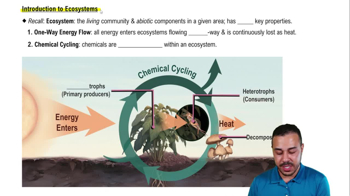
Ecosystem interconnections refer to the relationships and interactions between different species within a habitat. These connections include predator-prey dynamics, symbiotic relationships, and competition for resources, all of which contribute to the stability and health of the ecosystem. Understanding these interactions is crucial for grasping how species coexist and influence one another.
Recommended video:
Guided course
04:07
Introduction to Ecosystems

Evolutionary Relationships

Evolutionary relationships describe how different species are related through common ancestry and evolutionary processes. This concept is often illustrated through phylogenetic trees, which depict the evolutionary pathways and divergences among species. Recognizing these relationships helps in understanding biodiversity and the evolutionary history of life on Earth.
Recommended video:
02:45
History of Evolutionary Theory Example 1

Genetic Variability

Genetic variability refers to the diversity of gene frequencies within a population. It is essential for the process of natural selection, as it provides the raw material for evolution. High genetic variability within a species can enhance its ability to adapt to changing environments, making it a key factor in the survival and evolution of organisms.
Recommended video:
Related Practice
Textbook Question

Current rates of species extinction appear to be approximately

a. Equal to

b. 10 times lower than

c. 10 times higher than

d. 50 to 100 times higher than

e. 1000 to 10,000 times higher than

1669
views
Textbook Question

According to the generalized species-area curve, when habitat is reduced to 50% of its original size, approximately

a. 10%

b. 25%

c. 50%

d. 90%

1466
views
Textbook Question

Which cause of extinction results from humans' direct use of a species?

a. Overexploitation

b. Habitat fragmentation

c. Pollution

d. Introduction of competitors or predators

e. Global warming

862
views
Textbook Question

Which of the following is an example of a mutualistic relationship?

a. Moles catching and eating earthworms from the moles' underground tunnels

b. Cattails and reed canary grass growing together in wetland soils

c. Cleaner fish removing and eating parasites from the teeth of sharks

d. Colorado potato beetles consuming potato plant leaves

e. More than one of the above

1613
views
Textbook Question

The risks faced by small populations include

a. Erosion of genetic variability through genetic drift

b. Decreased fitness of individuals as a result of inbreeding

c. Increased risk of experiencing natural disasters

d. A and B are correct

e. A, B, and C are correct

1293
views
Textbook Question

One advantage of preserving more than one population of an endangered species at more than one location is

a. A lower risk of extinction of the entire species if a catastrophe strikes one location

b. Higher levels of inbreeding in each population

c. Higher rates of genetic drift in each population

d. Lower numbers of heterozygotes in each population

e. Higher rates of habitat fragmentation in the different locations

937
views