Pearson+ LogoPearson+ Logo
Ch. 17 - The Human Footprint
Belk, Maier - Biology: Science for Life 6th Edition
Belk, Maier6th EditionBiology: Science for LifeISBN: 9780135214084Not the one you use?Change textbook
Chapter 17, Problem 3

An ecological footprint
a. Is the position an individual holds in the ecological food chain
b. Estimates the total land area required to support a particular person or human population
c. Is equal to the size of a human population
d. Helps determine the most appropriate wastewater treatment plan for a community
e. Is often smaller than the actual land footprint of residences in a city

Verified step by step guidance
1
Step 1: Understand the term 'ecological footprint.' It refers to the measure of the impact a person or population has on the environment, expressed as the amount of land and water area required to sustain their use of natural resources and absorb their waste.
Step 2: Analyze the options provided in the question. Each option describes a different concept, so it is important to evaluate which one aligns with the definition of an ecological footprint.
Step 3: Eliminate incorrect options. For example, option (a) refers to an individual's position in the food chain, which is unrelated to the concept of ecological footprint. Similarly, options (c), (d), and (e) describe other unrelated ideas.
Step 4: Focus on option (b), which states that an ecological footprint estimates the total land area required to support a particular person or human population. This matches the definition of the term.
Step 5: Conclude that the correct answer is the one that aligns with the definition of ecological footprint, which is option (b).

Verified video answer for a similar problem:

This video solution was recommended by our tutors as helpful for the problem above.
Video duration:
56s
Was this helpful?

Key Concepts

Here are the essential concepts you must grasp in order to answer the question correctly.

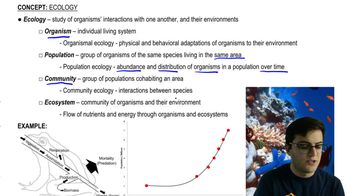
Ecological Footprint

The ecological footprint measures the environmental impact of an individual or population by calculating the total land and water area required to produce the resources consumed and absorb the waste generated. It reflects how much nature we have and how much we use, providing insight into sustainability and resource management.
Recommended video:

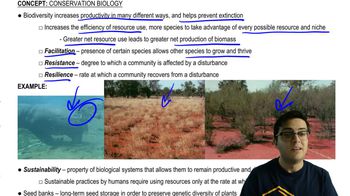
Sustainability

Sustainability refers to the ability to meet present needs without compromising the ability of future generations to meet their own needs. It encompasses environmental, social, and economic dimensions, emphasizing the importance of maintaining ecological balance while promoting human well-being.
Recommended video:
Guided course
05:06
Biodiversity and Sustainability

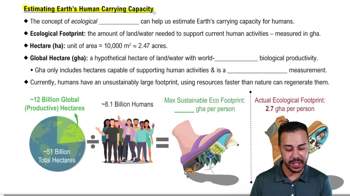
Carrying Capacity

Carrying capacity is the maximum population size that an environment can sustain indefinitely without degrading the ecosystem. It is influenced by resource availability, environmental conditions, and human activities, and understanding it is crucial for managing populations and their ecological footprints.
Recommended video:
Guided course
06:24
Estimating Earth’s Human Carrying Capacity