Pearson+ LogoPearson+ Logo
Ch. 17 - The Human Footprint
Belk, Maier - Biology: Science for Life 6th Edition
Belk, Maier6th EditionBiology: Science for LifeISBN: 9780135214084Not the one you use?Change textbook
Chapter 17, Problem 6

Which of the following biomes is most common on Earth's land surface?
a. Chaparral
b. Desert
c. Temperate forest
d. Tundra
e. Boreal forest

Verified step by step guidance
1
Understand the question: The problem is asking which biome is the most common on Earth's land surface. To solve this, we need to consider the characteristics and distribution of each biome listed in the options.
Step 1: Define each biome. For example: - Chaparral: Found in regions with hot, dry summers and mild, wet winters, typically near coasts. - Desert: Characterized by very low precipitation and extreme temperatures. - Temperate forest: Found in regions with moderate temperatures and significant rainfall, supporting deciduous and evergreen trees. - Tundra: Found in cold, treeless regions with permafrost. - Boreal forest (taiga): Found in cold climates, dominated by coniferous trees, and covering large areas of the Northern Hemisphere.
Step 2: Compare the global distribution of these biomes. For example, deserts cover about 20% of Earth's land surface, while boreal forests cover a larger area, particularly in the Northern Hemisphere. Chaparral and tundra are more limited in distribution compared to boreal forests and deserts.
Step 3: Consider the ecological significance and size of each biome. Boreal forests, also known as taiga, are the largest terrestrial biome, covering vast areas of Canada, Russia, and Scandinavia. This makes them more extensive than the other biomes listed.
Step 4: Based on the analysis, identify the biome with the largest coverage on Earth's land surface. The boreal forest (taiga) is the most common biome, as it spans a significant portion of the Northern Hemisphere.

Verified video answer for a similar problem:

This video solution was recommended by our tutors as helpful for the problem above.
Video duration:
1m
Was this helpful?

Key Concepts

Here are the essential concepts you must grasp in order to answer the question correctly.

Biomes

Biomes are large ecological areas on the Earth's surface, characterized by specific climate conditions, flora, and fauna. They are classified based on factors such as temperature, precipitation, and the types of vegetation present. Understanding biomes is essential for studying biodiversity and ecosystem dynamics.
Recommended video:
Guided course
01:38
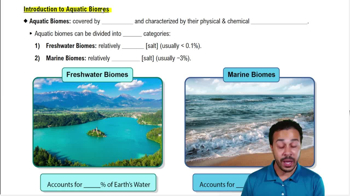
Introduction to Aquatic Biomes

Temperate Forest

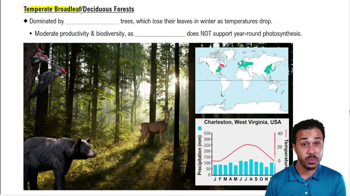
Temperate forests are characterized by moderate temperatures and distinct seasons, with a significant amount of rainfall throughout the year. These forests typically contain a mix of deciduous and evergreen trees, supporting diverse wildlife. They are one of the most common biomes in the world, particularly in regions like North America and Europe.
Recommended video:
Guided course
01:00
Temperate Broadleaf/Deciduous Forests

Boreal Forest

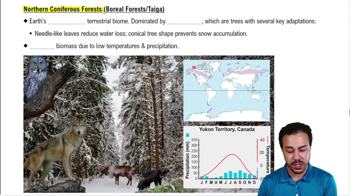
Boreal forests, also known as taiga, are found in high-latitude regions and are dominated by coniferous trees such as spruce and fir. They experience long, cold winters and short, mild summers, with moderate precipitation. Boreal forests cover a significant portion of the Earth's land surface, making them one of the largest biomes.
Recommended video:
Guided course
01:03
Northern Coniferous Forests (Boreal Forests/Taiga)
Related Practice
Textbook Question

An ecological footprint

a. Is the position an individual holds in the ecological food chain

b. Estimates the total land area required to support a particular person or human population

c. Is equal to the size of a human population

d. Helps determine the most appropriate wastewater treatment plan for a community

e. Is often smaller than the actual land footprint of residences in a city

1242
views
Textbook Question

Areas of low solar irradiation are

a. Closer to the equator than to the poles

b. Closer to the poles than the equator

c. At high altitudes

d. Close to large bodies of water

e. More than one of the above is correct

961
views
Textbook Question

The solar equator, the region of Earth where the sun is directly overhead, moves from 23.5°N to 23.5°S latitudes and back over the course of a year. Why?

a. Earth wobbles on its axis during the year

b. The position of the poles changes by this amount annually

c. Earth's axis is 23.5° from perpendicular to the rays of the sun

d. Earth moves 23.5° toward the sun in summer and 23.5° away from the sun in winter

e. Ocean currents carry heat from the tropical ocean north in summer and south in winter

2345
views
Textbook Question

Tundra is found

a. Where average temperatures are low and growing seasons are short

b. Near the poles

c. At high altitudes

d. A and B are correct

e. A, B, and C are correct

1541
views
Textbook Question

Which statement best describes the desert biome?

a. It is found wherever temperatures are high

b. It contains a larger amount of biomass per unit area than any other biome

c. Its dominant vegetation is adapted to conserve water

d. Most are located at the equator; e. It is not suitable for human habitation

1240
views
Textbook Question

Which of the following biomes has a structure made up primarily of the mineral deposits secreted by its dominant organisms

a. Coral reefs

b. Freshwater lakes

c. Rivers

d. Estuaries

e. Oceans

1066
views