Pearson+ LogoPearson+ Logo
Ch. 17 - The Human Footprint
Belk, Maier - Biology: Science for Life 6th Edition
Belk, Maier6th EditionBiology: Science for LifeISBN: 9780135214084Not the one you use?Change textbook
Chapter 17, Problem 4

Areas of low solar irradiation are
a. Closer to the equator than to the poles
b. Closer to the poles than the equator
c. At high altitudes
d. Close to large bodies of water
e. More than one of the above is correct

Verified step by step guidance
1
Understand the concept of solar irradiation: Solar irradiation refers to the amount of solar energy received per unit area. It is influenced by factors such as latitude, altitude, and proximity to water bodies.
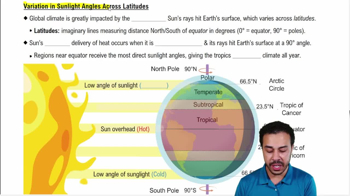
Recall the relationship between latitude and solar irradiation: Areas closer to the equator receive higher solar irradiation due to the direct angle of sunlight, while areas closer to the poles receive lower solar irradiation because sunlight strikes at a more oblique angle.
Consider the effect of altitude: High-altitude areas can receive more solar irradiation because the atmosphere is thinner, reducing the scattering and absorption of sunlight. However, this is not directly related to low solar irradiation.
Evaluate the role of large bodies of water: Proximity to large bodies of water can moderate temperatures but does not significantly affect the amount of solar irradiation received.
Analyze the options: Based on the above points, identify which option(s) correctly describe areas of low solar irradiation. Focus on latitude (closer to the poles) and eliminate options that do not align with the concept of solar irradiation.

Verified video answer for a similar problem:

This video solution was recommended by our tutors as helpful for the problem above.
Video duration:
2m
Was this helpful?

Key Concepts

Here are the essential concepts you must grasp in order to answer the question correctly.

Solar Irradiation

Solar irradiation refers to the power of solar radiation received per unit area, typically measured in watts per square meter. It varies significantly across the Earth's surface due to factors such as latitude, season, and atmospheric conditions. Areas closer to the equator generally receive more direct sunlight year-round, while regions near the poles receive less due to the angle of sunlight incidence.
Recommended video:
Guided course
02:29
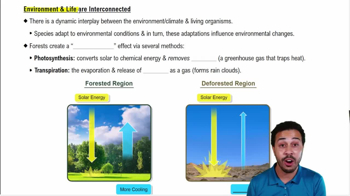
Environment & Life are Interconnected

Latitude and Climate

Latitude is a geographic coordinate that specifies the north-south position of a point on the Earth's surface. It plays a crucial role in determining climate patterns, including temperature and solar energy distribution. Regions at higher latitudes (closer to the poles) typically experience lower temperatures and reduced solar irradiation compared to those near the equator.
Recommended video:
Guided course
03:08
Variation in Sunlight Angles Across Latitudes

Altitude and Solar Exposure

Altitude, or elevation above sea level, can influence solar exposure and temperature. Higher altitudes often experience cooler temperatures and can have varying solar irradiation levels depending on geographic location. However, in some cases, high-altitude areas may receive more direct sunlight due to thinner atmosphere, but this does not necessarily correlate with overall solar energy availability compared to lower latitudes.
Recommended video:
Guided course
08:52
Air Movement and Partial Pressure
Related Practice
Textbook Question

Explain why the northern United States experiences a cold season in winter and a warm season in summer?

961
views
Textbook Question
Add labels to the figure that follows, which illustrates how various factors influence local climate.

897
views
Textbook Question

An ecological footprint

a. Is the position an individual holds in the ecological food chain

b. Estimates the total land area required to support a particular person or human population

c. Is equal to the size of a human population

d. Helps determine the most appropriate wastewater treatment plan for a community

e. Is often smaller than the actual land footprint of residences in a city

1242
views
Textbook Question

The solar equator, the region of Earth where the sun is directly overhead, moves from 23.5°N to 23.5°S latitudes and back over the course of a year. Why?

a. Earth wobbles on its axis during the year

b. The position of the poles changes by this amount annually

c. Earth's axis is 23.5° from perpendicular to the rays of the sun

d. Earth moves 23.5° toward the sun in summer and 23.5° away from the sun in winter

e. Ocean currents carry heat from the tropical ocean north in summer and south in winter

2345
views
Textbook Question

Which of the following biomes is most common on Earth's land surface?

a. Chaparral

b. Desert

c. Temperate forest

d. Tundra

e. Boreal forest

1399
views
Textbook Question

Tundra is found

a. Where average temperatures are low and growing seasons are short

b. Near the poles

c. At high altitudes

d. A and B are correct

e. A, B, and C are correct

1541
views