Pearson+ LogoPearson+ Logo
Ch. 2 - Science Fiction, Bad Science, and Pseudoscience
Belk, Maier - Biology: Science for Life 6th Edition
Belk, Maier6th EditionBiology: Science for LifeISBN: 9780135214084Not the one you use?Change textbook
Chapter 2, Problem 11

Which of the following lists the chemical bonds from weakest to strongest?
a. Hydrogen, covalent, ionic
b. Covalent, ionic, hydrogen
c. Ionic, covalent, hydrogen
d. Covalent, hydrogen, ionic
e. Hydrogen, ionic, covalent

Verified step by step guidance
1
Understand the types of chemical bonds: Hydrogen bonds are weak interactions between a hydrogen atom and an electronegative atom (e.g., oxygen or nitrogen). Ionic bonds occur between oppositely charged ions, and covalent bonds involve the sharing of electron pairs between atoms.
Recall the relative strength of these bonds: Hydrogen bonds are the weakest, ionic bonds are intermediate, and covalent bonds are the strongest.
Analyze the options provided in the question. Compare the order of bond strengths listed in each option to determine which one correctly arranges the bonds from weakest to strongest.
Focus on the correct sequence: Hydrogen bonds should come first (weakest), followed by ionic bonds (intermediate), and finally covalent bonds (strongest).
Select the option that matches this sequence: hydrogen, ionic, covalent.

Verified video answer for a similar problem:

This video solution was recommended by our tutors as helpful for the problem above.
Video duration:
6m
Was this helpful?

Key Concepts

Here are the essential concepts you must grasp in order to answer the question correctly.

Chemical Bonds

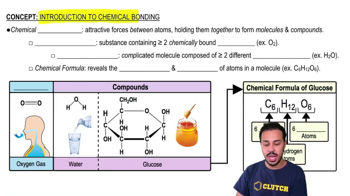
Chemical bonds are the forces that hold atoms together in molecules. The main types of chemical bonds include ionic, covalent, and hydrogen bonds, each differing in strength and the nature of the interaction between atoms. Understanding these bonds is crucial for predicting the properties of substances and their behavior in chemical reactions.
Recommended video:
Guided course
06:53
Introduction to Chemical Bonding

Ionic Bonds

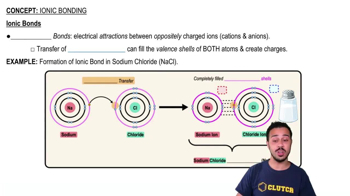
Ionic bonds are formed when one atom donates an electron to another, resulting in the attraction between positively and negatively charged ions. This type of bond is typically stronger than hydrogen bonds but weaker than covalent bonds. Ionic compounds often have high melting and boiling points due to the strong electrostatic forces between the ions.
Recommended video:

Covalent Bonds

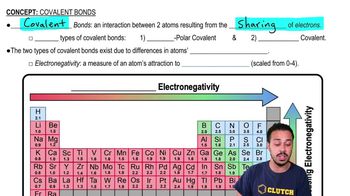
Covalent bonds occur when two atoms share one or more pairs of electrons, creating a strong bond that holds the atoms together. These bonds can vary in strength depending on the number of shared electron pairs, with double and triple bonds being stronger than single bonds. Covalent bonding is fundamental in the formation of organic molecules and biological macromolecules.
Recommended video:
Guided course
04:28
Covalent Bonds