
Pearson+ LogoPearson+ Logo
Ch, 15 - The Chromosomal Basis of Inheritance
Campbell - Campbell Biology 11th Edition
Urry11th EditionCampbell BiologyISBN: 9789357423311Not the one you use?Change textbook
Chapter 15, Problem 9

You design Drosophila crosses to provide recombination data for gene a, which is located on the chromosome shown in Figure 15.12. Gene a has recombination frequencies of 14% with the vestigial wing locus and 26% with the brown eye locus. Approximately where is a located along the chromosome?
<IMAGE>

Verified step by step guidance
1
Understand that recombination frequency is a measure of genetic linkage and is used to estimate the distance between genes on a chromosome. It is expressed as a percentage, where 1% recombination frequency is equivalent to 1 map unit (centimorgan).
Identify the recombination frequencies given in the problem: 14% with the vestigial wing locus and 26% with the brown eye locus. These frequencies suggest the relative distances between gene a and the other two loci on the chromosome.
Visualize the chromosome as a linear map where each locus is positioned based on recombination frequencies. The vestigial wing locus and the brown eye locus are reference points, and gene a is somewhere between them.
Calculate the approximate position of gene a by considering the recombination frequencies as distances. If gene a is 14 map units from the vestigial wing locus and 26 map units from the brown eye locus, it suggests that gene a is closer to the vestigial wing locus than to the brown eye locus.
Place gene a on the chromosome map by estimating its position relative to the other loci. Since gene a is 14 map units from the vestigial wing locus and 26 map units from the brown eye locus, it is likely located between these two loci, closer to the vestigial wing locus.

Verified video answer for a similar problem:

This video solution was recommended by our tutors as helpful for the problem above.
Video duration:
1m
Was this helpful?

Key Concepts

Here are the essential concepts you must grasp in order to answer the question correctly.

Genetic Recombination

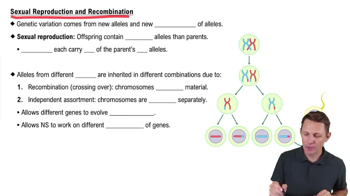
Genetic recombination refers to the process by which two DNA molecules exchange genetic material, resulting in new combinations of alleles. In Drosophila, recombination occurs during meiosis, and the frequency of recombination between two loci can indicate their relative positions on a chromosome. Higher recombination frequencies suggest greater physical distances between genes.
Recommended video:
05:08
Sexual Reproduction and Recombination

Linkage Maps

Linkage maps are diagrams that show the relative positions of genes on a chromosome based on recombination frequencies. These maps are constructed by analyzing the recombination data from genetic crosses, allowing researchers to estimate the distance between genes. In this context, the recombination frequencies between gene a and other loci help determine its approximate location on the chromosome.
Recommended video:
Guided course
01:29
Map of the Lesson on Biomolecules

Chromosomal Mapping

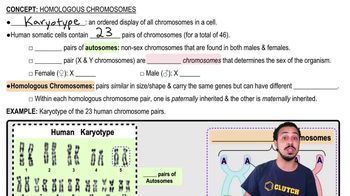
Chromosomal mapping involves determining the physical location of genes on a chromosome. By using recombination frequencies, scientists can infer the order and distance between genes. In the given question, the recombination frequencies of gene a with the vestigial wing and brown eye loci provide clues to its position, suggesting it is closer to the vestigial wing locus than the brown eye locus.
Recommended video:
Guided course
08:09
Homologous Chromosomes
Related Practice
Textbook Question

A planet is inhabited by creatures that reproduce with the same hereditary patterns seen in humans. Three phenotypic characters are height (T=tall,t=dwart), head appendages (A=antennae,a=no antennae), and nose morphology (S=upturned snout,s=downturned snout). Since the creatures are not 'intelligent,' Earth scientists are able to do some controlled breeding experiments using various heterozygotes in testcrosses. For tall heterozygotes with antennae, the offspring are tall antennae, 46; dwarf antennae, 7; dwarf no antennae, 42; tall no antennae, 5. For heterozygotes with antennae and an upturned snout, the offspring are antennae upturned snout, 47; antennae downturned snout, 2; no antennae downturned snout, 48; no antennae upturned snout, 3. Calculate the recombination frequencies for both experiments.

1828
views
Textbook Question

Using the information from problem 4, scientists do a further testcross using a heterozygote for height and nose morphology. The offspring are tall upturned snout, 40; dwarf upturned snout, 9; dwarf downturned snout, 42; tall downturned snout, 9. Calculate the recombination frequency from these data, and then use your answer from problem 4 to determine the correct order of the three linked genes.

1441
views
Textbook Question

A wild-type fruit fly (heterozygous for gray body color and red eyes) is mated with a black fruit fly with purple eyes. The offspring are wild-type, 721; black purple, 751; gray purple, 49; black red, 45. What is the recombination frequency between these genes for body color and eye color? Using information from problem 3, what fruit flies (genotypes and phenotypes) would you mate to determine the order of the body color, wing size, and eye color genes on the chromosome?

2707
views