
Pearson+ LogoPearson+ Logo
Ch. 20 - DNA Tools and Biotechnology
Campbell - Campbell Biology 11th Edition
Urry11th EditionCampbell BiologyISBN: 9789357423311Not the one you use?Change textbook
Chapter 20, Problem 7

Expression of a cloned eukaryotic gene in a bacterial cell involves many challenges. The use of mRNA and reverse transcriptase is part of a strategy to solve the problem of
a. Post-transcriptional processing.
b. Post-translational processing.
c. Nucleic acid hybridization.
d. Restriction fragment ligation.

Verified step by step guidance
1
Understand that eukaryotic genes often contain introns, which are non-coding sequences that need to be removed during post-transcriptional processing to produce mature mRNA.
Recognize that bacterial cells do not have the machinery to remove introns because they do not perform post-transcriptional processing like eukaryotic cells.
To express a eukaryotic gene in a bacterial cell, scientists use mature mRNA, which is already processed and free of introns, as a template.
Reverse transcriptase is an enzyme that synthesizes complementary DNA (cDNA) from the mature mRNA template. This cDNA is free of introns and can be inserted into bacterial cells.
By using cDNA, the bacterial cell can transcribe and translate the gene without the need for post-transcriptional processing, thus solving the problem of intron removal.

Verified video answer for a similar problem:

This video solution was recommended by our tutors as helpful for the problem above.
Video duration:
53s
Was this helpful?

Key Concepts

Here are the essential concepts you must grasp in order to answer the question correctly.

Post-transcriptional processing

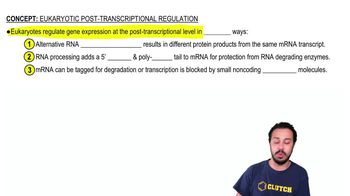
Post-transcriptional processing in eukaryotes involves modifications to pre-mRNA, including splicing, capping, and polyadenylation, to produce mature mRNA. This process is crucial because bacterial cells lack the machinery to perform these modifications. Using mRNA and reverse transcriptase allows the creation of cDNA, which bypasses the need for these eukaryotic-specific processes, enabling expression in bacteria.
Recommended video:
Guided course
01:56
Eukaryotic Post-Transcriptional Regulation

Reverse transcriptase

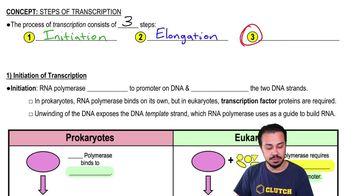
Reverse transcriptase is an enzyme that synthesizes complementary DNA (cDNA) from an RNA template. This enzyme is essential in cloning eukaryotic genes into bacteria because it allows the conversion of processed mRNA into cDNA, which can be inserted into bacterial plasmids. This process circumvents the need for eukaryotic post-transcriptional modifications, facilitating gene expression in prokaryotic systems.
Recommended video:
Guided course
04:16
1) Initiation of Transcription

Cloning in bacterial cells

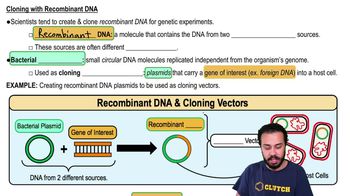
Cloning a eukaryotic gene in bacterial cells involves inserting the gene into a bacterial plasmid, which can replicate independently within the host cell. This process requires overcoming differences in gene expression mechanisms between eukaryotes and prokaryotes, such as the absence of intron splicing in bacteria. Using cDNA derived from mRNA ensures that only the coding sequences are cloned, allowing for successful expression in bacterial systems.
Recommended video:
Guided course
03:41
Cloning with Recombinant DNA