Ch. 34 - The Origin and Evolution of Vertebrates
Campbell - Campbell Biology 11th Edition
Urry11th EditionCampbell BiologyISBN: 9789357423311Not the one you use?Change textbook
Chapter 34, Problem 2

Living vertebrates can be divided into two major clades. Select the appropriate pair.
a. The chordates and the tetrapods
b. The urochordates and the cephalochordates
c. The cyclostomes and the gnathostome
d. The marsupials and the eutherians

Verified step by step guidance
1
Understand the concept of clades: In biology, a clade is a group of organisms that includes a common ancestor and all its lineal descendants. Clades are used to understand evolutionary relationships.
Identify the major clades of living vertebrates: Vertebrates are animals with a backbone, and they can be divided into major clades based on evolutionary traits.
Review the options provided: a. chordates and tetrapods, b. urochordates and cephalochordates, c. cyclostomes and gnathostomes, d. marsupials and eutherians.
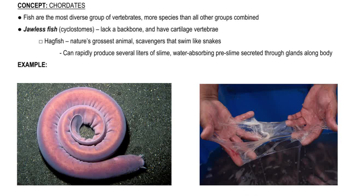
Focus on the clades that are specific to vertebrates: Cyclostomes (jawless vertebrates like lampreys and hagfish) and gnathostomes (jawed vertebrates) are two major clades within vertebrates.
Select the appropriate pair: Based on the understanding of vertebrate clades, the correct pair is c. cyclostomes and gnathostomes, as they represent the major division within living vertebrates.

Verified video answer for a similar problem:

This video solution was recommended by our tutors as helpful for the problem above.
Video duration:
1m
Was this helpful?

Key Concepts

Here are the essential concepts you must grasp in order to answer the question correctly.

Vertebrate Clades

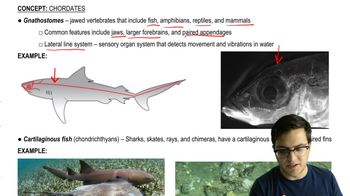
Vertebrates are animals with a backbone and can be divided into major clades based on evolutionary traits. The two primary clades are cyclostomes, which include jawless vertebrates like lampreys and hagfish, and gnathostomes, which are jawed vertebrates including fish, amphibians, reptiles, birds, and mammals.
Recommended video:

Cyclostomes

Cyclostomes are a clade of jawless vertebrates characterized by their elongated bodies and lack of paired fins. They include species such as lampreys and hagfish, which are considered primitive vertebrates due to their simple structure and evolutionary history predating jawed vertebrates.
Recommended video:

Gnathostomes

Gnathostomes are vertebrates that possess jaws, a significant evolutionary advancement that allowed for more diverse feeding strategies. This clade includes a wide range of species, from fish to mammals, and is distinguished by the presence of paired limbs and a more complex skeletal structure compared to cyclostomes.
Recommended video: